|
|
 |
|
The
Sixth Doctor
(1984 - 1986) |
|
|
|
|
|
|
The
Sound Vault |
|
 |
|
 |
|
| Peri |
|
|
The Best Doctor
|
| |
| Vote
if I am your favourite Doctor |
|
|
|
|
|
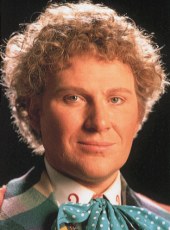
 After
the almost unassuming nature and appearance of the Fifth
Doctor,
his replacement following his death by Spectrox Toxaemia made
a shockingly vivid contrast in terms of personality and appearance.
While the Fifth Doctor had commonly worn a rather casual cricket
outfit with a long coat, the most distinctive thing about his
appearance being a stick of celery, the Sixth Doctor made no
attempt to fade into the background, his common choice of clothing
being a long multi-coloured coat that looked like it had been
thrown together from a variety of random materials, apparently
intended by the producers to represent his ‘fractured
and unstable psyche’, the only actual patch of sanity
in his wardrobe being his white shirt. After
the almost unassuming nature and appearance of the Fifth
Doctor,
his replacement following his death by Spectrox Toxaemia made
a shockingly vivid contrast in terms of personality and appearance.
While the Fifth Doctor had commonly worn a rather casual cricket
outfit with a long coat, the most distinctive thing about his
appearance being a stick of celery, the Sixth Doctor made no
attempt to fade into the background, his common choice of clothing
being a long multi-coloured coat that looked like it had been
thrown together from a variety of random materials, apparently
intended by the producers to represent his ‘fractured
and unstable psyche’, the only actual patch of sanity
in his wardrobe being his white shirt.
 |
| The Twin Dilemma |
|
Although he occasionally
varied this clothing by wearing an all-blue version of the coat
on some occasions after spending more time in this incarnation
- even wearing relatively normal clothing while spending time
in England in 1936 to investigate historical interference ("Players"),
tracking an alien computer system ("Blue
Box"), or
participating in a British attempt to infiltrate a Nazi mission
in 1944 ("The
Shadow in the Glass") - in general the
Sixth Doctor’s clothing is best described as resembling
a hippie bus that crashed into a paint factory, frustrating
many of his companions due to his apparent refusal to accept
that his clothing commonly attracted the wrong kind of attention
and apparently completely convinced that he genuinely looked
good.
The Doctors’ refusal to blend in physically is further
reflected by his more outgoing, vocal personality, generally
being seen as the loudest Doctor, expressing his own opinions
to an extreme greater than any of his other selves, loudly
proclaiming quotes and discoveries or making reference to
past trips while other Doctors would have just casually dropped
them into the conversation. While the Fifth Doctor rarely
lost his temper expect in particularly extreme circumstances,
the Sixth was known for much of his first year for engaging
in more than the occasional vocal confrontation with his companion
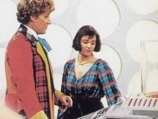
Peri, the two regularly arguing about everything from The
Doctor’s occasionally selfish behaviour to Peri’s
use of her ‘barbaric’ New Englandisms ("...ish").
He also regularly engaged in debates with his companions,
such as when he told his companion Evelyn Smythe that historians
by their very nature would never be able to reveal the truth
as history was always written by the victors ("Jubilee"),
or when he gave a group of Cambridge scientists elaborate
lectures about the nature of time and the universe after discovering
that they had created a machine - the TITAN Array - which
would allow them to observe the higher dimensions of reality
("The
Quantum Archangel").
 |
| The Twin Dilemma |
|
Part of the reason for
this Doctor’s more ‘in-your-face’ personality
doubtless ties in to his ego. While his past incarnations
had never been entirely humble, with the Second
Doctor proclaiming
himself a genius more than once and the Fourth
Doctor stating ‘Even
I am occasionally wrong sometimes’ ("Genesis
of the Daleks"), this Doctor displayed an exceptional ego
from the beginning of his life. Unlike his other selves, who
initially expressed dissatisfaction or uncertainty about their
new faces after their regenerations and took a while to get
used to them, the Sixth Doctor immediately began to praise
his new appearance, regarding it as ‘beaming with a
vast intelligence’ and dismissing his previous self
as possessing a ‘feckless charm’ that wasn’t
him ("The
Twin Dilemma"), later expressing frustration
with his second self after he was captured by the Sontarans ("The
Two Doctors"). He generally demonstrated a
supreme confidence in his abilities, once stating that he
could easily blend in when attempting to infiltrate a Nazi
base despite his outrageous clothing on the grounds that he
assumed the attitude of a man who deserved to be there and
knew it ("The Shadow in the Glass"), and on another
occasion feeling let down that he couldn’t even think about how great he was because he was in the presence of a
telepath ("Instruments
of Darkness"). Although it
should be noted that his faith in abilities may not have been
a significant exaggeration, given that he was the first Doctor
to repair the chameleon circuit, the fact that he reset it
to the police box shape when the TARDIS’s new forms
still refused to blend in to their surroundings - and sometimes
even made it hard to find the door - does detract from the
scale of this accomplishment ("Attack
of the Cybermen").
Even
his choice of companions further reflected his unwillingness
to fade into the background, one of this Doctor’s companions
being the shape-shifting Whifferdill known as Frobisher,
a private detective from a distant colony who nevertheless
spent
much of his time as a penguin because he found it ‘relaxing’.
He also spent a great deal of time in the company of the equally-strong-willed
history lecturer Evelyn
Smythe (In another contrast to his
usual companions, Evelyn was in her late forties when she
joined The Doctor while traditional companions were only in
their twenties), recognising in her a personality easily as
strong as his own and a personal strength that belied her
age.
 |
| Attack of the Cybermen |
|
Although this often resulted in conflict between the
two of them - most notably when she attempted to leave history
as it was after the two of them apparently witnessed the birth
of Julia instead of Julius Caesar ("100
BC"), although
matters were later resolved when it was revealed that they
had actually gone back in time rather than forward when attempting
to see the birth, and had hence witnessed the birth of Caesar’s
virtually-unknown older sister - the two of them got along
fairly well, The Doctor describing her as the most well-prepared
and useful companion he’d ever had early on in her travels
with him ("The
Marian Conspiracy"), combing a strength
of character with a personal warmth that allowed her to form
fast friendships with such diverse figures as Charles Darwin
("Bloodtide")
or Daft Jamie ("Medicinal
Purposes").
While less resolute than Evelyn, his companion Peri was also
known for catching attention, her beauty and strength of character
earning her the attention - both appreciated and undesired
- of many of the individuals they met on their travels, Peri
always demonstrating a personal strength that allowed her
to stand up even The Master and
The Rani simultaneously
("Mark
of the Rani"). Even temporary companion Claire Aldwych proved a worthy ally during her tragically short time with
him, aiding The Doctor and The
Brigadier in uncovering a conspiracy
stretching back to the end of the Second World War and helping
them track the location where The
Fourth Reich had established
their headquarters ("The Shadow in the Glass").
On
many occasions in this incarnation the Sixth Doctor could
appear more heartless than some of his other selves (Although
he preferred to think of himself as pragmatic, describing
himself as being more rational and less outwardly sentimental
rather than heartless ("Palace
of the Red Sun")), increasing his reputation as possibly
one of the most dangerous Doctors. Over the course of his
life, The Doctor showed little hesitation in such actions
as rigging a laser gun to fire at approaching soldiers before
he was even aware of the nature of the situation he had found
himself ("Vengeance
on Varos"), beating an android to death with the
TARDIS hat stand to stop it accessing the console ("Time
of Your Life"), and even committed genocide to save
Earth from the Vervoids (Although
it should be noted that, as pointed out by the Eighth
Doctor, they were merely an artificially-created life
form rather than one that had evolved naturally into its current
state) ("Terror
of the Vervoids"). His most notable morally questionable
act was in his dealings with the Galyari, a conquering race;
to prevent them ever being a threat again, The Doctor was
able to use an elaborate computer system to infuse the entire
species with a racial memory of him as the monstrous Sandman,
who stole the skins of Galyari children (The Doctor having
taken the skins from corpses to properly interface with their
tissue-sensitive computer systems) and who caused pain on
sight (Due to the Galyari’s sensitive vision having
trouble looking at The Doctor’s multi-coloured coat).
However, his dislike of violence remained despite his occasional
use of it, The Doctor urgently asking Tom Dekker - his temporary ‘bodyguard’ during
a prolonged visit to 1936 - not to shoot a group of German
agents who were following the two of them on a visit to Winston
Churchill’s estate ("Players"), and teaching
the newly-sentient robot Green-8 that one should only resort
to physical violence when all other options were exhausted
("Palace of the Red Sun").
 |
| Vengeance on Varos |
|
Following
his trial on Gallifrey for meddling in the affairs of the
universe, however,
The Doctor mellowed significantly,
his actions tempered by fear of becoming The
Valeyard - a
personification of the darkest aspects of his nature, created
between his twelfth and final selves - to the extent that
he briefly contemplated exiling himself to the planet Torrok
to avert The Valeyard’s creation before another mission
from the Time Lords forced him to recognise that he could
not abandon the people of the universe that he had long ago
vowed to defend ("Time of Your Life"). His time
with Evelyn in particular seemed to help him mellow from his
original attitude, The Doctor describing her as a steadying
influence on him after her departure due to her willingness
to challenge him on various issues. Although their relationship
soured on occasion after he was unable to save Cassie Schofield
from the ruthless vampire Nimrod ("Project:
Lazarus"),
Evelyn nevertheless continued to appreciate her time with
him, constantly encouraging him to take action when he felt
depressed ("Pier
Pressure") and vocally defending
The Doctor to the ruthless egotistical time-traveller Doctor Robert Knox when he claimed to be on a humanitarian mission
in the past. ("Medicinal Purposes").
 |
| Revelation of the Daleks |
|
Despite his
occasionally brutal nature, The Doctor nevertheless retained
his compassion when it counted. This compassion was
particularly highlighted in his relationships with his companions;
although he and Peri had a hostile relationship after his
regeneration - The Doctor making an effort to overcome this
after he recognised that he subconsciously ‘blamed’ her
for the death of his fifth self ("Burning
Heart")
- he nevertheless showed great grief when he witnessed her
apparent death during his trial, and was profoundly grateful
when he learned that she had survived (Although he never actually
travelled back to confirm her survival; as The Doctor
told later companion Grant
Markham, his guilt over Peri’s
death was so strong that he preferred not to definitively
find out as he could at least imagine that she was still alive
if he didn’t know one way or the other). His pain at
Peri’s loss was so great that it resulted in him leaving
his later companion Grant Markham at the Bi-Al Foundation
after Grant was nearly killed during one of their adventures
when he linked his mind to a computer being attacked by a
virus, the encounter leaving Grant bitter and rejecting The
Doctor’s attempt to apologise even as he reminded The
Doctor that he couldn’t hold himself personally responsible
for what happened to those who chose to travel with him. The
Doctor was also profoundly affected by the death of Claire
Aldwych after she was killed by Nazis to serve as a substitute
body for Eva Braun ("The Shadow in the Glass"),
despite the fact that she had only travelled with him and
The Brigadier for a brief period of time.
As well as his compassion
for his companions, the Sixth Doctor was very eloquent in
showing his affection for other beings,
spending a great deal of time during a crisis on the planet
Esselven Minor helping a robot called Green-8 explore the
sentience that he had accidentally evolved over the course
of his long life ("Palace of the Red Sun"), as well
as naming and conversing with a matter-manipulating entity
that had been enslaved by his old friend/foe The Rani after
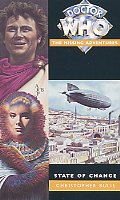
she had simply treated it as a slave ("State
of Change").
Even when faced with the powerful Cylox, who had destroyed
entire civilisations simply because they were bored and playing
games, The Doctor still mourned their deaths when they were
killed by their jailer, recognising that the Cylox, for all
their power and lack of compassion for other species, had
been nothing but children ("Instruments
of Darkness").
Although his compassion was particularly evident in this incarnation,
his anger at injustice was also regularly expressed to great
extent, as was most keenly demonstrated when The Doctor vocally
condemned Rochester - the insane Prime Minister of Britain
in an alternate timeline where Britain conquered Earth with
Dalek technology - for his claims that he was only ‘pretending’ to
be evil to avoid being killed by the Daleks who controlled
others (It was never clear whether he believed that story
or just used it to make himself feel better). The Doctor not
only told Rochester that he had to act like a good
man to be one, but later went on to address the British Empire
in
a televised broadcast to tell them that they had become worse
than the Daleks as they had become monstrous killers without
even the excuse that they had been ‘programmed’ as
such, commenting that the humans and Daleks were now almost
as bad as each other ("Jubilee").
 |
| The Mysterious Planet |
|
Despite his larger-than-life
attitude, he sometimes appeared more fatalistic than some
of his other selves, brooding on
more than one occasion that he was doomed to die when faced
with a problem that lacked any apparent villain for him to
challenge, such as when the TARDIS appeared to run out of
power in the Time Vortex ("Vengeance on Varos"),
when he discovered evidence that suggested that a temporal
embolism had allowed his second self to be killed while his
own existence remained - thus creating a paradox that could
destroy the universe in a few centuries - (Although the Second
Doctor’s ‘death’ was later revealed to be
a deception) ("The Two Doctors"), or when he discovered
what appeared to be his own grave on the planet Necros ("Revelation
of the Daleks"). Although this personality trait
reached its peak when he once contemplated suicide ("Killing
Ground") to avert the existence of the Valeyard, The
Doctor became more comfortable in his life as time went on,
his bleaker moods limited to a period of depression after
a ‘couple of misadventures’ ("Pier Pressure"),
baring the occasional minor brooding session when faced with
such problems as failing to find a question that the super-computer
Mentos would be unable to answer ("The
One Doctor").
A particularly dark period for him occurred after he accidentally
triggered a nuclear war on the planet Maradnias, The Doctor
briefly contemplating settling down on a single planet to
cope with his grief before The Master’s attempt to tap
into the Lux Aeterna forced him back to action, culminating
in the Chronovores and the Eternals undoing his visit to Maradnias
as thanks for his assistance in restoring stability to the
universe ("The Quantum Archangel"). Despite this,
his occasionally bleak mood never hindered his appreciation
for the smaller details that made life enjoyable and beautiful
in the universe, ranging from appreciating his companion Evelyn’s
chocolate cake recipes to enjoying a relaxing rest in the
gardens of Esselven Minor ("Palace
of the Red Sun").
The
Doctor eventually met his end when confronting The Lamprey,
a being of great power that sought to devour all alternate
timelines ("Spiral
Scratch"). Reflecting this Doctor’s
always larger-than-life personality, this crisis required
him to ally himself with his own alternate selves, multiple
versions of the Sixth Doctor - including a one-eyed Doctor
in dark clothing from a reality where the Roman Empire never
ended and a Doctor from a world where humans and Silurians lived
together and even had hybrid children - banding together as
the Lamprey began to devour alternate timelines to sustain
her own bloated existence. With no other way to defeat her,
The Doctors were forced to ‘overfeed’ her with
their own chronal energy, countless alternate Doctors sacrificing
their existences to preserve their universes from the Lampreys’ foul
taint, the ‘prime’ Doctor - The Doctor we know
- giving the last of his energy to hold the Lamprey down while
his other selves focused their own energy against their foe.
As the other Doctors returned to their original timelines, The Doctor, weakened and apparently aged by the chronal energy he had lost, returned to the TARDIS, putting the ship into hover mode so he could look at the universe one last time, the subsequent turbulence caused by The Rani’s tractor beam and the radiation around Lakertya injuring the already-weakened Doctor to the point where he was forced to regenerate ("Time
and the Rani") (Although this regeneration was also influenced by a future version of The Doctor from a timeline where The Valeyard took over his body, the future Doctor ‘nudging’ his past self to travel towards Lakertya so that he would regenerate and thus shake off the Valeyard’s influence before it could take full control ("The Brink of Death")).
 |
| The Ultimate Foe |
|
Even
after death, however, the Sixth Doctor’s legacy
remained, his seventh self’s recollection of his past
self growing increasingly corrupted as time went on. It was
gradually revealed over time that the unborn Seventh
Doctor - the aspect of the Dooctor that
would be that resided in The Doctor’s subconscious -
believing that the Sixth Doctor was approaching a point where
he would have become
the Valeyard after his meeting with Mel and the confrontation
with the Vervoids, was responsible for the Sixth’s regeneration
by deliberately steering him into The Rani’s tractor beam (Possibly some subconscious misinterpretation of the alternate Sixth Doctor’s memory of his alternate self), the Seventh's memory of his previous incarnation becoming so corrupted and twisted that, by the time of The
Doctor’s twelfth regeneration, the Sixth Doctor’s
mental representation in The Doctor’s mind would be
used to create the Valeyard. Initially the Seventh Doctor
attempted to prevent this by sealing and confining his sixth
self in his mind with the aid of his other five past selves
("Head
Games"), refusing to let him out from fear
of what the Sixth Doctor might become. However, this ‘imprisonment’ ended
when, after a near-death experience that resulted in him waking
up in his own coffin ("The
Room With No Doors"),
the Seventh Doctor recognised that he was still The Doctor
in all his incarnations, allowing him to forgive his past
self’s sins and remove the guilt that would have led
to the Sixth Doctor’s memory becoming the Valeyard, ‘purifying’ his
memory of his previous self and restoring the Sixth Doctor
to normal. This improved relationship was further reflected
when the Eighth Doctor visited his former self ("The
Eight Doctors"), recognising that his past self’s
bluster concealed a man who genuinely cared about the universe
despite his occasionally harsh attitude.
|






 BOOK
BOOK