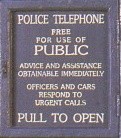
Throughout the history of Doctor Who, the
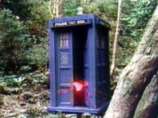
TARDIS has long been the one constant in the show. Companions have
departed or died, adversaries have been defeated, destroyed or just
never come back to the series, The Doctor rarely visits planets more
than once (With the obvious exception of Earth), even The Doctor
himself will eventually regenerate... but the TARDIS itself, with
its familiar blue Police Box shape, has long remained a constant
in the series, right from that moment in "An
Unearthly Child" when
a pacing policeman shone his torch on the box as it stood in the
scrapheap, throbbing slightly, as though alive with power. Throughout the history of Doctor Who, the
TARDIS has long been the one constant in the show. Companions have
departed or died, adversaries have been defeated, destroyed or just
never come back to the series, The Doctor rarely visits planets more
than once (With the obvious exception of Earth), even The Doctor
himself will eventually regenerate... but the TARDIS itself, with
its familiar blue Police Box shape, has long remained a constant
in the series, right from that moment in "An
Unearthly Child" when
a pacing policeman shone his torch on the box as it stood in the
scrapheap, throbbing slightly, as though alive with power.
One of the most distinctive aspects of the
TARDIS is its vast interior, far larger on the inside than it is
on the outside. This is attributed to it being 'dimensionally transcendental',
which was explained to Leela by the Fourth
Doctor using the analogy
of how a larger cube can appear to be able to fit inside a smaller
one if the larger cube is further away, yet immediately accessible
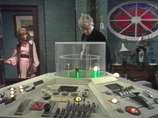
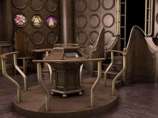
at the same time. Apart from the obvious feature of the console room,
containing the controlling console, the TARDIS interior also includes
an art gallery containing some of history's great works (Rescued
by The Doctor from disasters which history states destroyed them),
a bathroom with a swimming pool, a swimming pool, the architectural reconfiguration system - consisting of multiple glass eggs that allow the ship to make whatever it needs -, a medical bay, several brick-walled
storage areas, a vast library, a wardrobe room containing clothes
from all eras of humanity (Although The Doctor rarely uses this,
preferring to wear the same outfit throughout his incarnation, certain
incarnations were prepared to vary some little details, such as the
colour of their jackets (the Third
Doctor) or the pattern of their
waistcoats (the Sixth
Doctor)), and, of course, living quarters for
The Doctor's various companions. There is also a secondary console
room, apparently made of wood, which the Fourth Doctor used for a
year before returning to the original model, although he reconfigured
it in his seventh incarnation into a more gothic-looking formation,
which was used by the Eighth
Doctor until the TARDIS interior was
practically vaporised by a cold fusion reactor exploding within it
in "The
Gallifrey Chronicles", thus necessitating its regeneration
into the console room used in the new television series. he exact size of the TARDIS has never been specifically confirmed, although when the interior dimensions were mapped onto the exterior it dwarfed even The Doctor's home planet of Gallifrey ("The Ancestor Cell"), the Twelfth Doctor once stated that the TARDIS's true weight could flatten the surface of Earth ("Flatline"), and the Seventh Doctor materialised the entire TARDIS around an alternate Earth to prevent the detonation of nuclear warheads by trapping the entire planet in the TARDIS's state of temporal grace ("Blood Heat").
 |
| The Very
First Appearance |
|
The TARDIS is, essentially, The Doctor's only true
home in the entire series. Even when the Third Doctor was exiled
on Earth, finding a new, if unorthodox, family among his colleagues
at UNIT, the TARDIS was still the main reason he stayed with the
organisation in the first place, taking a job as Scientific Advisor
to the organisation to acquire parts to repair the TARDIS. Although
it has been said on many cases that the TARDIS is not fully operational
- indeed, in "The Gallifrey Chronicles", Marnel, the TARDIS's
previous owner, stated that only ten per cent of the TARDIS's necessary
functions aren't working (Including, for some bizarre reason, animal-language
translators) -, and it was regarded as an out-of-date model even
when The Doctor left Gallifrey - he had the chance to depart in a
Type Fifty-Three but decided to take a nearby Type Forty despite
its age on the grounds that the 53s were too soulless, his decision also aided by the temporally-displaced future companion Clara Oswald informing him that he would have more fun in this ship ("The Name of The Doctor") -, the TARDIS always seems to have all the necessary features that a space/time
machine carrying any possible species would need. These include the
ability to protect its passengers during transportation and upon
arrival at potentially hostile destinations, to show them where they
have landed on a view screen (Although since the screen shows them
the absolute positive value of coordinates, it isn't much use in
the parallel reality of E-Space where coordinates are negative),
to allow them to understand any language - even capable of translating
when not dealing in vocally-spoken languages, such as when the Seventh
Doctor and
his companion Elizabeth
Klein spoke with an insectoid
race known as the Vrill who communicated by smell, the TARDIS’s
translation matrix providing a basic language structure that The
Doctor and Klein could use to communicate ("Survival
of the Fittest") -, a yearometer (Giving them
their location in space as well as time), a food machine - although
it simply produced basic food bars that mimicked the taste and nutritional
requirements of the food but lacked details like texture; The Doctor
has since been said to have installed a proper kitchen in the ship
-, a wardrobe, various security precautions to prevent the ship materialising
in an environment that would prove hostile to its passengers - such
as the heart of a sun or the bottom of an ocean -, and necessary
living quarters for its passengers, along with a power source, and,
of course, the ability to set coordinates and get from A to B by
travelling through the fifth dimension of the Time Vortex with any
necessary diversions that might be required during the trip.
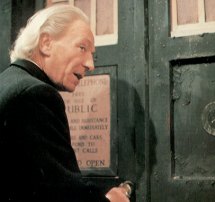 |
| Outside
with the First Doctor |
|
The TARDIS's steering abilities, of course,
are one of the prominent points that caused The Doctor to argue with
his companions (Although it was recently revealed that temporally-displaced companion Clara Oswald was partly responsible for this error, informing The Doctor as he prepared to leave Gallifrey that he would have more fun in the TARDIS with the broken navigation circuit ("The Name of The Doctor")). For The Doctor's first two incarnations, he was unable
to steer the TARDIS to anywhere that he claimed he would get it to;
even if the First
Doctor reached Earth with Ian and Barbara when
he said he was going there, he was always at least a few decades
out from his target ("The
Time Travellers"), and the Second
Doctor was only able to pilot an exact course in the TARDIS when
responding to a distress signal by disabling many of the ship’s
usual security protocols ("The Murder Game"). In "Heart
of TARDIS", the Second Doctor attributed his piloting difficulties
to security devices installed by his people which, in the event of
a theft, prevent the pilot from getting exactly where he wants to
go, although given that he still had some problems in his next few
incarnations, when he'd sorted out his differences with his people
and his third self's exile had been lifted, it would appear that
he wasn't being totally honest, later novels stating that he had
never actually passed his basic time travel proficiency test - the
Time Lord equivalent of a driver’s licence - in the first place
("Festival
of Death"), stating when asked why he never
took the tests that he found such qualifications pointless.
It was later explained in novels such as "The
Taking of Planet 5" that normally control of the TARDIS
is an automatic feature formed by the Time Lord practically ‘imposing’ his
mind on the TARDIS via a direct telepathic link, with The Doctor’s
piloting problems being partly caused by the fact that, in order
to escape the Time Lords after leaving Gallifrey, he was forced to
stop himself from forming a full link with the TARDIS to prevent
himself leaving an energy signature that could be easily traced.
As a result, The Doctor had to construct new controls for the TARDIS
out of physical matter rather than the block transfer computations
that were normally used, thus preventing him from exerting total
control over the TARDIS while also granting them both a degree of
freedom beyond what they would have experienced among Time Lord society.
Despite the complications involved in this method of TARDIS control,
in general The Doctor appears to have overcome any serious problems
he might have encountered in controlling the TARDIS by his fourth
incarnation, being capable of mastering short ‘hops’ in
space without moving anywhere in time ("Full
Circle"). However, despite his skills later in his lives, his piloting skills are often somewhat erratic after recent
regenerations, such as the Fifth
Doctor’s difficulty in returning
Tegan
Jovanka to Heathrow ("The
Visitation"), the Eighth Doctor
briefly landing in another dimension ("One Fateful Knight"),
or the Eleventh Doctor being two years late to pick up new companion Amy Pond ("The Eleventh Hour")
and a month late for a meeting with Winston
Churchill ("Victory of the Daleks").
Post-regenerative disorientation aside, by the present time in the
series, even with
such problems as his eighth self's century-long amnesia following
his battle with Faction
Paradox in "The
Ancestor Cell" and his subsequent regenerations after the
loss of his people, The Doctor appears to have mastered how to control
the TARDIS when he has a location that he specifically needs to get
to, although he still tends to overshoot if there is no overriding
need to arrive at a particular location (Hence why the Ninth
Doctor materialised at the Powell estate twelve months after
he and Rose Tyler originally left as opposed to the twelve hours he was
aiming for ("Aliens
of London/World War Three")), and generally still appears
content to set the coordinates to random and see where the TARDIS
takes him ("Planet
of the Ood"). It should also be noted that, when it was temporarily transferred into a human form, the TARDIS stated that it takes The Doctor where he needs to go even if it doesn’t take him where he wants to go ("The Doctor's Wife"), suggesting that some of its apparently incorrect trips may be the result of the TARDIS influencing the destination rather than simple piloting errors of The Doctor’s part. This idea was reinforced when the Twelfth Doctor told new companion Bill Potts that he did not 'steer' the TARDIS, but just negotiated with it, with the result that he could travel into the future ("Smile") but ended up going back to the London frost fair of 1814 when he was intending to return to his university office in 2017 ("Thin Ice"), even if he was subsequently able to take the TARDIS on a short spatial hop away from the frozen Thames to park on a nearby bridge. Although future companion River Song once claimed that the noise the TARDIS makes when materialising
only happens because The Doctor leaves the brakes on, given that
other TARDISes have been shown to make that noise in the series -
coupled with it being unlikely for The Doctor to repeatedly make
the same amateurish piloting mistake, especially when he was travelling
with Romana -, it seems more likely that River merely activated a ‘stealth
materialisation’ method that allows the TARDIS to materialise
quietly, The Doctor never using this method himself because, unlike
Time Lords who used working chameleon circuits to silently observe
history, he prefers to be involved in events and attract attention
rather than hiding from it. (An idea that was supported when The
Doctor used a ‘stealth materialisation’ method in "The Impossible Astronaut/Day
of the Moon" when travelling to the
Oval Office).
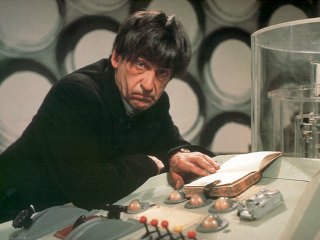 |
| Inside
with the Second Doctor |
|
Outside of The Doctor’s occasional piloting
difficulties, the TARDIS's most predominate inoperative feature is,
of course, its chameleon circuit. Normally, this device is meant
to change a TARDIS into something that blends in seamlessly with
its surroundings - or, in the case of the Eighth Doctor’s companion
Compassion, who became a living TARDIS due to an unexpected chain
of circumstances, assume the appearance of another person ("The
Fall of Yquatine") -, but the TARDIS's chameleon circuit has
remained a Police Box ever since it left Totter's Lane in 1963 in
the pilot episode (Originally, the producers were going to include
a working chameleon circuit, but it was deemed to be too expensive
to supply all the props necessary for such a feature, and so the
idea was scrapped), regardless of what other repairs The Doctor has
carried out to the ship. (It was recently revealed that the Eleventh Doctor was responsible for the circuit breaking in the first place, having gone back to Totter’s Lane to damage the circuit so that he could use the image of the TARDIS’s police box exterior as a protective symbol in humanity’s racial memory, thus preventing humanity from being forced to worship a race known as the Prometheans as gods ("Hunters of the Burning Stone")). Typically, Time Lords rely on the chameleon
circuit to allow themselves to visit the various times and worlds
they travel to in order to allow them to observe the societies in
secret, but given The Doctor’s natural distaste for his peoples’ disinclination
to get involved he preferred to leave the ship and explore rather
than wait inside the ship and observe everything on the screen ("The
Time Travellers"), thus limiting his interest in repairing the
circuit.
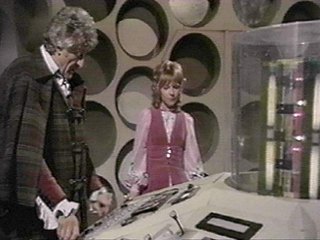 |
| The Third Doctor |
|
On two occasions since then, the Sixth and
Seventh Doctors
have successfully managed to repair the circuit (The Fourth Doctor
contemplated repairing it but was distracted when The Master's
latest scheme nearly destroyed the Universe and made him regenerate
("Logopolis")),
but they both ended up resetting it back to its default Police Box
form; the Sixth Doctor ("Attack
of the Cybermen") became frustrated at the circuit’s
new problem of turning the TARDIS into objects that still simply
refused
to blend in with its new location - as well as its disguises making
it hard for him to find the door, such as when it turned into a Victorian
kitchen range -, and the Seventh Doctor ("Conundrum" and "No
Future") concluded, after The
Meddling Monk hacked into the circuit and nearly gave the TARDIS
away, that he preferred a single fixed shape to multiple appearances
susceptible to outside influence. Since then, The Doctor has appeared to be satisfied with the Police Box shape; indeed, in "Boom Town", the Ninth Doctor specifically stated that he likes the TARDIS as it is, with the ship's only real change in appearance in the modern series occurring when the Twelfth Doctor was forced to activate a 'siege mode' to protect a shrunken TARDIS suffering from a power drain, converting the TARDIS exterior to a small box with Gallifreyian sigils on it and no visible door until additional power was supplied ("Flatline"). Although he cannot change the TARDIS's appearance under normal circumstances, The Second and Eleventh Doctors have each demonstrated the ability to turn the TARDIS invisible, both by accident and on purpose ("The Invasion" and "The Impossible Astronaut/Day of the Moon"), while retaining its usual police-box shape, although the obvious difficulties in finding the TARDIS in this condition explains why The Doctor rarely uses it.
Other, lesser-used parts of the TARDIS include
among their number the time safe, a permitted temporal paradox that
must be used sparingly; unlike normal safes, where things are put
in for future use, in a time safe, things are put in later for prior
use. To date, the only recorded use of the safe was when the Fifth
Doctor and Turlough used to send a diary to their past selves that
led to them facing the mysterious beings known as the Vrall on the
moon of 1878 ("Imperial
Moon") (There has been some speculation that the safe may
have been used by the Seventh Doctor to send himself notes about
problems he would later face, but this remains only a theory). There
is also the Jade Pagoda (Named for its resemblance to Lao Tzu's structure
of that name), which serves as an escape pod in the event of the
TARDIS running into trouble, and draws the main TARDIS to it when
the danger has passed - or, if damage is done to the Jade Pagoda,
it returns to the TARDIS when the damage becomes too great - ("Iceberg", "Sanctuary"),
as well as other, more basic ‘life rafts’ used to provide
the TARDIS with extra space which can be removed from the ship if
needed ("City
at World's End"), although this can render the ship’s
internal dimensions slightly unstable until it becomes used to the
absence. One of the more practical components of the TARDIS is the
Time Vector Generator (Or the TVG) which resembles an eighteen-inch
long gold stick with one white end; when extracted, it causes the
TARDIS to lose its link to the interior dimensions, reverting it
to a simple Police Box (Or whatever it looks like at the time) until
the TVG is reinstalled ("Invasion
of the Cat-People", "The
Wheel in Space"). A recently-displayed feature of the TARDIS is the ‘voice interface’ program, where it can communicate with its pilot to provide relevant information in cases where the crew either cannot access or cannot see the ship’s monitors by projecting a hologram, apparently creating images of people that it has encountered to inform them of vital information. When initially demonstrated, this feature projected an image of The
Brigadier to allow the TARDIS’s ‘dark side’ to communicate with Rassilon, The Doctor and his companions ("Zagreus") amid an elaborate projection of historical events, but the interactive nature of this incarnation may have been aided by the anti-time contaminating the TARDIS. On another occasion, the Tenth
Doctor interacted with a TARDIS projection that manifested as his old companions when he was trapped in the remnants of the Time Lord Matrix, buts its apparent reliance on the companions’ personalities suggested that this was more of a psychic defence rather than a direct communication ("The Forgotten"). More recent projections have lacked the interactive nature of the earlier versions, simply focusing on providing The Doctor ("Let's
Kill Hitler") and Clara Oswald ("Hide") with relevant information assuming a suitable form (Clara saw herself and The Doctor was presented with an image of Amy Pond as the child he originally met her as, dismissing projections of Rose Tyler, Martha Jones and Donna Noble due to the associated guilt).
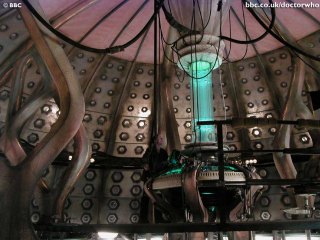 |
| Inside The Ninth Doctor's TARDIS |
|
Another useful TARDIS component is the HADS,
or Hostile Action Displacement System, which causes the TARDIS to
dematerialise whenever a weapon is used against it that may cause
it damage and reappear a short distance away ("The
Krotons", "Mission:
Impractical"). However, this function can be difficult to
set, with the Third Doctor once accidentally making the HADS so sensitive
that it activated when the TARDIS was caught in a regular hail storm
("The
Suns of Caresh"), and the Eleventh Doctor’s
tinkering causing the ship to travel all the way to the South Pole
when he materialised in a sinking submarine stationed at the North Pole ("Cold War"). Whether an additional feature or just an upgrade to the original HADS, by The Doctor's twelfth incarnation the TARDIS's emergency features also include the Hostile Action Dispersal System, which disperses the TARDIS into its component molecules when faced with a potentially destructive attack so that it can reconstitute itself after receiving a suitable signal ("The Magician's Apprentice/The Witch's Familiar").
The TARDIS has also been shown to possess
a force field, although this function is rarely used since the TARDIS
is
strong enough on its own, and, in any case, that function appears
to have been disabled following the Time War - beyond the force field
required for essential basic functions such as preventing the air
being sucked out if the TARDIS doors open in a vacuum ("The
Horns of Nimon", "The
Runaway Bride", "The Stolen Earth/Journey's
End") -, since the Ninth Doctor was forced to wire up an
external device to protect himself and his companions from the Daleks in "The
Parting of the Ways". The TARDIS also used to possess a
Zero Room, an area where Time Lords can go to recuperate after a
traumatic regeneration; since the Zero Room is sealed off from the
rest of the universe, Time Lords are able to relax and focus on reorganizing
their new personality without interference from the outside world.
However, The Doctor only used it at the beginning of his fifth incarnation
- previous regenerations stabilising outside the ship due to The
Doctor’s inability to tell his companions about the Zero Room
-, and it was lost in the subsequent escape from Event One when 25%
of the TARDIS’s mass was ‘deleted’ to provide the
ship with extra power ("Castrovalva"),
although the Seventh Doctor reconstructed it shortly before the novel "Deceit".
However, one of the few extra features in the TARDIS that actually
has an impact on where the TARDIS goes is the Fast Return Switch,
a switch that causes the TARDIS to go back to a previous destination
if pressed correctly; if used too often, or stuck in one position,
as shown in "The
Edge of Destruction", the TARDIS can go all the way back
to the beginning of the universe itself, at which point the intense
gravity can tear the power source of the ship away.
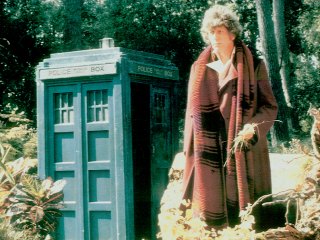 |
| The Fourth
Doctor |
|
The TARDIS's power source has remained one
of the more interesting points in the series. There were hints in
the earlier stories, such as in "The
Daleks", when it was established that the TARDIS requires
mercury for its fluid links in order to travel anywhere, but it wasn't
until "The
Three Doctors" that it was specifically stated that the
time-travelling capabilities of the Time Lords were powered by a
trapped black hole, named in "The
Deadly Assassin" as the
Eye of Harmony, although the TARDIS does require other energy sources
to function properly, such as the rare ore Zeiton Seven ("Vengeance
on Varos") and artron energy, a form of energy generated by
Time Lord minds, apparently generated by the TARDIS during materialisation;
during "The Wedding of Sarah Jane Smith", Sarah
Jane Smith’s teenage ally Clyde Langer was able to injure
the near-omnipotent Trickster after he came in contact with the TARDIS
while it was trying to materialise in a time trap, due to him becoming
temporarily ‘charged’ with artron energy. During his
exile on Earth, the Third Doctor removed the TARDIS console from
the main ship in an attempt to get around the blocks the Time Lords
had placed on the ship during his exile ("Inferno"),
using the energy of a nuclear reactor to 'jump-start' the ship, but
this was only a temporary measure and the console soon ran out of
power after only a couple of trips, The Doctor never managing to
time-travel more than a few seconds into the future while also making
short spatial shifts.
Despite Gallifrey's destruction in "The
Ancestor Cell", and thus also the loss of the Eye of Harmony,
the TARDIS has somehow managed to keep going after it finished repairing
from the energy drain it had sustained in the destruction of Gallifrey
(""Escape
Velocity"), suggesting that it has been fitted with an alternative
source of power to the Eye; indeed, in "Boom Town" and "Utopia",
The Doctor parked the TARDIS over a dimensional rift in Cardiff to
refuel, confirming that it now operates independent from Gallifrey,
with Cardiff being used as a ‘pit stop’ to top up its
power. However, given that in "The Gallifrey Chronicles" the
TARDIS still seems to be linked to a black hole, it seems a fair
assumption that there are still some aspects of the Eye in existence
that the TARDIS can access, but the TARDIS must periodically tap
into another source of power in order to maintain the connection
between it and the Eye fragments now that the direct link to Gallifrey
has been lost.
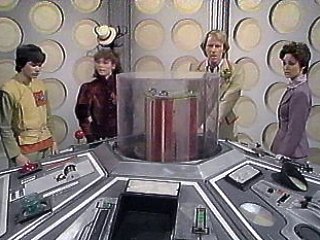 |
| The Fifth Doctor |
|
During "Rise
of the Cybermen/The Age of Steel", when the TARDIS was briefly
transported into a parallel universe, The Doctor stated that the
TARDIS actually draws its power from the universe as a whole, and
it was thus inoperative in parallel realities (Although this was
never a problem when the TARDIS was sent to multiple alternate worlds
during the "Fractured Reality" saga when the actions of
the Eighth Doctor's foe Sabbath resulted
in the barriers between parallel worlds being broken down from "Time
Zero" to "Sometime
Never...", this was most likely because these alternate
realities had temporarily ‘replaced’ the ‘true’ reality
rather than The Doctor having travelled to a different universe).
The 2006 Christmas Special "The Runaway Bride" also revealed
that the TARDIS's power source is connected to Huon particles, a
long-lost source of energy that is naturally inert unless they catalyse
inside something alive but unravel the atomic structure if exposed
to them on a long-term basis, but the importance of Huon energy to
the ship's operation on a daily basis is unclear. When The Doctor
was pitted against the beings known to fans as the 'Weeping
Angels'
- beings who fed off the energy of lives they'd sent into the past
- the Angels sought to acquire the TARDIS to feed on the time energy
within it, but this attempt was averted thanks to the actions of
Sally Sparrow, a young woman in the present who'd acquired video
footage of The Doctor based on information he'd acquire from her
in the future.
Although the TARDIS is easily capable of travelling
through time in our own universe, its ability to go to other universes
where history diverged from our own has varied on some occasions.
In "Battlefield", the Seventh Doctor revealed that travelling
into parallel universes is referred to as travelling sideways in
Time, but it has also been stated that the TARDIS has various safety
blocks that prevent it from materialising in a universe other than
our own. Although these features were briefly disabled in "Heart
of TARDIS" (When the Second Doctor was trying to get rid of
the blocks the Time Lords had installed that prevented him from taking
the TARDIS where he wanted to go) and "Inferno" (When the
Third attempted to bypass the blocks the Time Lords had installed
again that prevented him from dematerialising during his exile),
The Doctor always restored them, and remained content with being
'limited' to this universe. Apart from the obvious exceptions of
history in the 'prime' reality being altered by outside forces (Such
as "Timewyrm:
Exodus", "Timewyrm:
Exodus", or "Timewyrm:
Genesys"), The Doctor's only other visits to parallel realities
occurred during the events of the 'Fractured Reality' saga and "Rise
of the Cybermen/The Age of Steel", when the ship fell through
a crack in the Time Vortex that took the entire ship into an alternate
reality. Although it commonly travels from place to place by dematerialising
and travelling through the higher dimension of the Time Vortex, "The
Runaway Bride" demonstrated that the TARDIS was capable of 'flying'
through the air almost like a regular spaceship, but such a feature
is clearly draining for the ship - judging by the fact that it was
subsequently out of action for a few hours - suggesting that it was
never designed to operate like that.
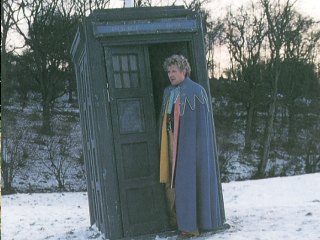 |
| The Sixth
Doctor |
|
Another matter for debate in the series is a simple one; is the TARDIS alive? At the start of the series, the First Doctor rejected the merest suggestion of such a concept, regarding the TARDIS as a mere machine ("The Edge of Destruction"), but, eventually, he began to acknowledge that it was far more than that, even telling his companion Steven
Taylor, at the conclusion of their meeting with Dodo Chaplet and their battle with the so-called 'Gods of the Latter-Day Pantheon' ("Salvation"), that he would do well to remember that the TARDIS had a mind of its own. By the time he was in his fourth incarnation, The Doctor was acting as though the TARDIS was self-aware on a regular basis, some of his companions doing the same, such as K9 once referring to the TARDIS as 'a very stupid machine' due to its inability to speak ("The
Invasion of Time"). Even before the TARDIS’s sentience was fully established, it is clear that The Doctor and the TARDIS share a particularly powerful bond; when the Master attempted to undo The Doctor’s history by planting a conceptual bomb that would destroy the TARDIS by erasing it from existence ("The Light at the End"), this one act negated all of The Doctor’s travels in time and space rather than history simply adjusting as The Doctor now took a different ship, suggesting that the TARDIS has played its own role in influencing The Doctor's destinations where other ships would not have taken The Doctor where he needed to go ("The Doctor's Wife").
As time went on, however, the TARDIS began to demonstrate a greater sense that it was an individual in its own right rather than just The Doctor’s means of transport. By the time of his sixth incarnation, the TARDIS was shown to have likes and dislikes, to the extent that it actually ‘refused’ to protect Charley from the mysterious Mila when she was infected by Mila’s viruses and turned invisible, apparently due to the TARDIS’s dislike of the temporal paradoxes Charley had caused in her time with The Doctor ("Patient
Zero"). By contrast, Melanie
Bush had a strong feeling that the TARDIS was saying goodbye to her when she once contemplated leaving The Doctor ("The
Quantum Archangel"), the same adventure seeing the TARDIS briefly terrified to let The Doctor near it after it was almost forced to Time Ram its own past self by a nanovirus planted by The Master. On a later occasion, the Seventh Doctor briefly acquired an alternate version of his TARDIS when he was separated from the original and was forced to start travelling in a version of it from a timeline where his third incarnation had been murdered ("Blood
Heat"), with the new TARDIS taking a while to trust him, to the extent that it showed more sympathy for his companion Ace than The Doctor himself ("The
Dimension Riders"). Despite this, The Doctor was eventually able to bond with the ship, The Doctor travelling comfortably in the ‘new’ TARDIS until his original ship was restored to him ("Happy
Endings"), the TARDIS’s bond with The Doctor remaining strong ever since.
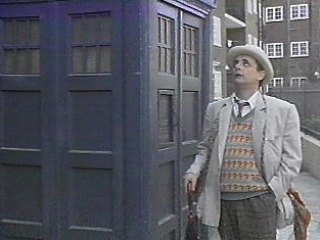 |
| The Seventh Doctor |
|
Although the TARDIS is The Doctor's closest
friend, it has had to experience some very traumatic events in its
time with The Doctor. One of the worst was in "Frontios",
when it was literally destroyed by a meteor storm triggered by gravity-controlling
insects known as 'Tractators', but it was pulled back together when
the Fifth Doctor tricked the head Tractator - known as the Gravis
- into pulling it back together; since the interior then existed
in its own separate dimension, the Gravis was cut off from the other
Tractators, and all of them were shut down, as the Gravis was the
source of their power. In many ways, the Fifth Doctor is The Doctor
who was most careless with the TARDIS; although he still cared for
his ship, he had a great deal of trouble inside it in this incarnation,
problems ranging from something as simple as forgetting to close
the door ("Warriors
of the Deep") to being attacked by
hostile androids ("Earthshock", "Spare
Parts" and "Planet
of Fire", among others), and
even losing it twice during the search for the Key to Time when it
was ejected into hyperspace after landing on spaceships, The Doctor
only regaining it due to the unintentional machinations of The
Black Guardian ("The
Judgement of Isskar", "The
Destroyer of Delights", "The
Chaos Pool"). By comparison, the Sixth Doctor was far more careful with the TARDIS, with its worst experiences in this lifetime being a temporary power drain after being caught in the Rani's plan to replace her own lost console ("State of Change"), although it also endured a traumatic near-time-ram of its own past self while facing enraged Chronovores ("The Quantum Archangel").
However, the TARDIS endured some of its most bizarre experiences after The Doctor regenerated into his seventh incarnation, one of the earliest recorded incidents being when a cannonball struck the ship with such force that it damaged the outer casing ("The Angel of Scutari"). While it regenerated from the damage, the 'prime' TARDIS assumed a white version of its usual exterior shell, The Doctor using its regeneration to create a smaller black-exterior TARDIS to hunt a series of Elder Gods while keeping his current companions safe ("Black and White"), the storyline ending with both TARDISes reintegrating via symbiotic propulsion in preparation for the final confrontation with the restored Fenric ("Gods and Monsters"). Even after it was restored to its blue appearance and full potential, the TARDIS experienced further trauma after an attack by an alien parasite caused the TARDIS to collide with an early Gallifreyian Time Scaphe, resulting in the TARDIS being spread out into a vast city, torn between three different timelines, haunted by the Seventh Doctor's ghost and populated by early Gallifreyians who believed that The Doctor had stolen their future. Although the TARDIS managed to help
Ace restore The Doctor to normal, two different versions of the parasite
teamed up with a rogue Gallifreyian to try and kill The Doctor, with
The Doctor only being saved when he tricked the parasite into killing
its infant self, restoring the Gallifreyians to their proper places
in time. However, when The Doctor finally managed to repair his ship,
the TARDIS was infected by a shard of demonic protoplasm in the process,
resulting in the TARDIS’s interior becoming warped, with a
corridor stretching to infinity or arton energy strands being tainted
with streaks of green along with various other malfunctions, as well
as The Doctor becoming increasingly withdrawn from Ace and his new
companion Benny due to his telepathic link to the ship. Unable to
get rid of the infection as it always knew what he was doing, The
Doctor was forced to spend several months reprogramming the tertiary
console to the new Zero Room without consciously thinking about it,
thus allowing The Doctor to cut himself off from the universe and
wait until Ace - who had recently left the TARDIS - returned to him
to help restore his memories ("Deceit"). Shortly after
it was cured of the virus, the TARDIS was also lost in an alternate
Earth created by the Meddling Monk after it crash-landed into a tar
pit ("Blood Heat"); indeed, the Seventh Doctor genuinely
thought that the TARDIS had been destroyed, subsequently travelling
in the alternate TARDIS of that other reality - the Third Doctor
of that universe having been killed by the Silurians and
his regeneration interrupted by the Meddling Monk - until it was
returned by the mysterious Muldwych ("Birthright"),
who revealed it had escaped the destruction of that alternate Earth
by riding on a Fortean Flicker, a temporal anomaly that displaced
people and objects from their proper places in space and time ("Happy
Endings"). The alternate version of the TARDIS was given
to Muldwych, and The Doctor departed for more adventures in his old
ship, grateful to have his old home/friend back with him.
The Doctor and the TARDIS were later separated once again when The
Doctor’s current companion Elizabeth Klein - a Nazi from an
alternate timeline that The Doctor had tricked her into erasing,
The Doctor attempting to reform her - literally stole the TARDIS
to recreate her own history ("Survival of the Fittest").
Klein’s temporal interference proved to be so serious that
The Doctor was forced to provide the Nazi resistance in that timeline
with a device that permanently severed the TARDIS’s connection
to its interior dimensions, essentially ‘killing’ his
old friend in order to stop Klein, although the TARDIS was restored
to him when he passed the Time Lords’ sentence against Klein
and erased her from history, thus undoing all that she had done ("The
Architects of History").
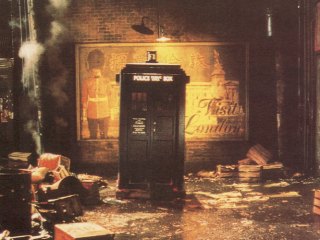 |
| The Television
Movie |
|
The next two occasions where the TARDIS faced its
own death, however, are almost proof that the TARDIS is sentient;
indeed, it could almost be assumed from these that the TARDIS is
in love with The Doctor! In "Neverland",
the Eighth Doctor was forced to materialise the TARDIS around an
anti-time 'bomb' to prevent it contaminating the universe and save
the life of his companion Charley.
Although the risky manoeuvre worked, the results were horrific; The
Doctor and the TARDIS were infected by anti-time, their minds splitting
into two personalities. The Doctor's anti-time side - named "Zagreus" after
an old Gallifreyian nursery rhyme - was merely a destructive maniac,
but the TARDIS's evil side based itself around a more specific emotion;
jealousy at the fact that The Doctor was willing to sacrifice it,
his oldest friend, to save a foolish girl who shouldn't have been
alive in the first place. Forming an alliance with Rassilon,
the TARDIS's Zagreus-side nearly destroyed The Doctor's mind when
it had its old shell melted down, but there was enough good left
in the TARDIS to give Charley (Along with former companions Leela
and Romana) a chance; with the aid of three holograms based on the
Fifth, Sixth and Seventh Doctors, The Doctor/Zagreus was able to
fight off Rassilon and overcome the Zagreus part of him, although
he then exiled himself to the anti-time universe for a while until
the infection was removed. During his time in the anti-time universe,
The Doctor was briefly separated from the TARDIS and trapped on a
planet divided into various ‘zones’, forcing him, Charley,
and new companion C’rizz to work with a mysterious entity called
the Kro’ka to travel through the zones to track down the TARDIS,
until they arrived in a maze and the TARDIS was able to send The
Doctor a message. With the TARDIS restored to him, The Doctor departed
the anti-time universe with his companions, leaving the deceitful
Kro’ka to its fate.
After that, the TARDIS's next case of near-destruction
could be traced all the way back to the Third Doctor, although the
effects only caught up with The Doctor in his eighth incarnation
while he was travelling with Fitz Kreiner and Compassion. In his third incarnation,
The Doctor's history was altered by the group known as Faction Paradox,
who, by tricking the Eighth Doctor, lured the Third onto the distant
planet of Dust, where he was shot in the chest and forced to regenerate
ahead of schedule. As a result (Due to it having been released earlier),
the Faction's biodata virus was able to infect The Doctor while his
biological defences were focused on helping him regenerate, although
it would take some while to take effect. Indeed, at the very least,
his fourth, fifth and sixth incarnations would definitely be the
same as they were in the original history, and the seventh had a
good chance of turning out fine as well, but the virus would have
definitely affected the Eighth Doctor if the TARDIS hadn't taken
the virus into itself when the Third Doctor regenerated inside it,
realising that history had somehow gone onto the wrong track. Desperate
to restore history, the TARDIS even managed to hold itself together
after it was destroyed when it got caught between the reality barriers
between this world and the Land of Dreams ("The
Shadows of Avalon"), latching on to a power source in the
form of a Universe in a Bottle and regenerating itself around it
over the course of five thousand years in the Vortex. After spending
centuries trying to get the infection under control, the TARDIS eventually
appeared over Gallifrey - the source of the Bottle - in the form
of a vast Gallifreyian flower of remembrance, its interior having
been mapped onto its exterior so that it was the exact same size
inside and outside. Appearing to be made of bone due to the Faction
virus inside it, the TARDIS manifested defences against intruders
in the form of giant bone spiders, a connotation to the timeline
it was trying to restore ("Planet
of the Spiders"), and, at the console room, the dust particles
assembled themselves into the form of the Third Doctor - or at least,
the 'temporal ghost' of the Third Doctor who should have been before
the Faction messed with his history.
 |
| The Ninth Doctor (with Rose) |
|
In a final confrontation on the twisted TARDIS,
where the Eighth Doctor and the Third's 'ghost' faced off against
Grandfather Paradox, the twisted future version of The Doctor that
would be created by the virus, the Eighth Doctor drained off the
TARDIS's energy by firing its long-dormant weapons systems, thus
forcing one timeline to become real; fortunately, it was the uninfected
one, although The Doctor then had to erase his own memory to transfer
the Time Lord Matrix into his subconscious while the TARDIS collapsed
down to the size of a snuff box. Taken to late nineteenth-century
Earth by his friend Compassion, The Doctor was left to recover from
what he'd had to do while the TARDIS regenerated itself, the two
of them leaving Earth in 2001 ("Escape Velocity"), accompanied
by old companion Fitz Krienier and new companion Anji Kapoor, ready for new adventures.
Although The Doctor’s piloting skills at this point were fundamentally
limited due to his lack of memory, he generally managed to operate
it by instinct enough to get around in the universe, steering the
ship through various gravitational anomalies around a strange planet
("Vanishing
Point"); even if he failed to take his companion Anji back
to 2001 like she requested for some time, he demonstrated the ability
to take the TARDIS on short hops when the situation was necessary,
such as moving the ship to airports ("Trading
Futures") or materialising around a planet-destroying bomb
("The
Book of the Still"). He even had a brief encounter with
the TARDIS's original owner, Marnal, a Time Lord agent who was exiled
to Earth after his actions caused a fly-like race called the Vore
to evolve into a race of parasitic nomads rather than the benevolent
species they would have been, Marnal briefly trying to take the TARDIS
back and put The Doctor on trial for Gallifrey's destruction before
he died during the Vore's subsequent invasion of Earth.
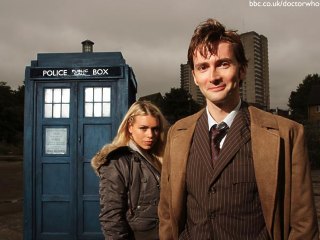 |
| The Tenth Doctor (with Rose) |
|
Since then, Fitz and Anji have gone their separate
ways, The Doctor's memories have been restored, and he has regenerated
once more, his ninth incarnation being joined in his travels by new
companion Rose Tyler... and, for the first time in the show's history,
The Doctor has specifically said 'The TARDIS is alive',
rather than just making enigmatic comments or simply treating it
like it was alive. This occurred in the story "Boom Town",
when his old adversary Margaret Blaine, really a Slitheen in
disguise, tried to destroy the Earth by channelling the TARDIS's
energy through a device that would enlarge a rift in time. However,
knowing Margaret was trying to destroy it, the TARDIS, tapping into
her thoughts and desires, revealed the Time Vortex to Margaret, turning
her back into an egg and giving her a second chance at life, away
from the criminal influence of her Slitheen family.
Shortly after this, the TARDIS's link to the Time
Vortex was again accessed, this time by Rose Tyler, who had been
sent back home in the ship while The Doctor and new companion Captain Jack Harkness faced off against an army of around half a million Daleks.
Eventually, when everyone else on the satellite where the battle
had been waged was dead, the only way The Doctor could stop the Daleks
was by triggering a delta wave, which would fry the brain of every
living Dalek... but, unable to refine the wave in the time he had,
The Doctor would annihilate all life on Earth as well. Just as The
Doctor was about to be exterminated, Rose returned, now imbued with
the power of the Vortex... and, with this power, she turned the entire
Dalek fleet to dust, before The Doctor took the energy into himself
to save her life at the cost of his ninth incarnation. For a brief
time after The Doctor's regeneration, the TARDIS was forced to devote
all its power to keeping the Tenth
Doctor stable, resulting in a
temporary shut-down of features such as the translators, preventing
Rose from understanding alien languages until The Doctor woke up.
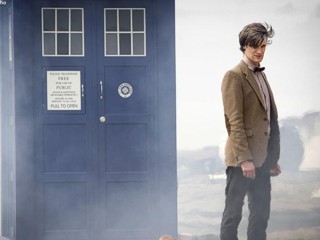 |
| The Eleventh Doctor |
|
Even after the Tenth Doctor
stabilised, however,
the TARDIS’s time under the Tenth Doctor’s control was
far from easy; not only was it briefly trapped in a parallel universe
after it fell through a crack in the time vortex- causing it to shut
down until The Doctor could 'recharge' it due to it drawing power
from our universe ("Rise
of the Cybermen/The Age of Steel")
-, but it was also stolen by the newly-regenerated Master, who,
unable to pilot it anywhere but early 21st-century Earth and the
end of the universe after the Doctor locked the coordinates, cannibalised
it to create a Paradox Machine that created a massive rift above
Earth, before Jack Harkness destroyed the machine and The Doctor
subsequently restored the TARDIS to normal ("The
Sound of Drums/Last of the Time Lords") (Although it did
take a brief knock when it collided with a younger version of itself
("Time
Crash")
and a starship based on the Titanic due to The Doctor having forgotten
to turn the shields back on ("Voyage
of the Damned")).
On an interesting note, however, The Doctor’s connection with
the TARDIS has greatly improved in this incarnation, The Doctor learning that he can now open and close the TARDIS doors merely by clicking his fingers without the need for a key ("Silence
in the Library/Forest of the Dead"), while on another occasion
he was able to shift it a second out of sync with the universe merely
by aiming his key at it, thus concealing it from anyone who might
try to steal his ship ("The End of Time"). Although the
Tenth Doctor’s subsequent regeneration caused serious damage
to the console room, forcing the TARDIS to reconstruct itself to
repair the damage, the Eleventh Doctor appears to be perfectly happy
with his new console room - the TARDIS even providing him with a
new sonic screwdriver after his old one was damaged during his confrontation
with Prisoner
Zero ("The Eleventh Hour") -, continuing
to travel comfortably in the TARDIS (Although the new controls have
resulted in The Doctor missing his target when travelling more than
once, such as being a month late for a meeting with Winston Churchill
("Victory of the Daleks") or landing in England when he
was aiming for Rio ("The Hungry Earth/Cold Blood").
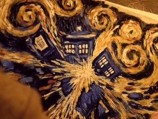 |
| The Pandorica Opens/The
Big Bang |
|
During this time, The Doctor briefly believed that
the TARDIS was destined to be destroyed in a temporal explosion on
26th June 2010 that would cause cracks in reality after he discovered
a fragment of ‘shrapnel’ in one crack in the form of
a piece of the TARDIS’s door ("The Hungry Earth/Cold Blood").
This ‘prediction’ eventually came true when the TARDIS
was diverted to that date while future companion River Song was attempting
to pilot the TARDIS to The Doctor while he was investigating the
mysterious legendary ‘Pandorica’ underneath Stonehenge
- said to contain the most dangerous being in the universe, later
revealed to have been designed by The Doctor’s enemies to imprison
The Doctor himself to stop him causing the cracks -, the
resulting explosion destroying every sun in the universe by triggering
a total
event collapse of every moment in history except the interior of
the Pandorica. Fortunately, the TARDIS was able to preserve Earth
by locking itself in a time loop at the moment of its ‘death’,
the power of its destruction serving as a substitute sun to keep
Earth warm and its history intact until The Doctor arrived in the
present. By taking the Pandorica into the exploding TARDIS, The Doctor
was able to use the remaining few billion atoms of the original universe
that had been preserved inside the Pandorica to ‘jump-start’ the
universe - the equivalent of cloning a body from a single cell -,
restoring the universe to existence, even though he believed that
the subsequent explosion would erase him from existence. Despite
being caught at the heart of the explosion - which should have supposedly
ensured his erasure from history -, Amy’s memories of The Doctor
proved sufficient to restore him and the TARDIS to life along with
her erased family (Although the mystery of what caused the explosion
in the first place remains to be solved, even after The Doctor’s
confrontation with The Silence ("The Impossible Astronaut/Day
of the Moon")).
 |
| The Doctor's Wife |
|
After a close call involving the TARDIS
being nearly stolen by the renegade Shansheeth as
part of a plan to rewrite history and undo
death ("Death of the Doctor"), The Doctor experienced a
particularly personal encounter with the TARDIS when its soul was
transferred into a human body as part of a plan by the malevolent
entity House to
consume the TARDIS, removing the TARDIS’s soul
so that its destruction wouldn’t destroy House himself while
leaving the exterior saturated with the artron energy that House
could feed on. Although the TARDIS initially had trouble communicating
with The Doctor due to its inexperience with a physical form and
the strain of its essence being compressed into such a small form,
The Doctor realised the truth just before House transferred himself
into the TARDIS to travel back to The Doctor’s universe to
find a new food source, leaving him to assemble components from the
TARDISes that House had previously eaten into a makeshift console
that he and the TARDIS could use to follow the main ship.
 |
Assimilation2
Issue 1 |
|
Although
the TARDIS had trouble expressing itself verbally at first - and
even seemed to have trouble with the concept of names, to the extent
that it thought that Rory
Williams was the ‘pretty one’ of
he and Amy Pond, and called itself ‘Sexy Thing’ because
The Doctor had referred to it as such on occasion -, it/she eventually
gained a better understanding of its/her new body, commenting to
The Doctor as they assembled a new console that she had wanted to
see the universe just as much as him when they first departed Gallifrey,
noting that, while she rarely took him where he wanted to go, she
always took him where he needed to go.
As House tormented Amy and
Rory using his control of the TARDIS interior to lead them through
shifting corridors and generate illusions, the TARDIS was able to
make telepathic contact with Rory (Although The Doctor had meant
for her to reach Amy) and direct them to an old console room that
the TARDIS kept in ‘storage’ so that they could shut
down the shields and allow her and The Doctor to return to the ship.
Although the TARDIS’s human body began to die from the strain,
The Doctor was able to save her by tricking House into deleting the
room they were in; an automatic safety feature of the TARDIS transferred
its passengers into the main console room, allowing the TARDIS’s
soul to return to its rightful place and banish House from itself.
Using the last of the energy in its borrowed body, the TARDIS used
its last moments of speech to thank The Doctor for everything that
he had done for her, assuring The Doctor that he would never be alone
as long as she was with him (The TARDIS briefly assumed a human form
when The Doctor travelled into the Star Trek universe ("Star
Trek: The Next Generation/Doctor Who: Assimilation2"), but this
was only a temporary measure, the ship transferring its consciousness
into the android Lieutenant Commander Data to protect itself from
a Borg attempt to assimilate the TARDIS, allowing the Data/TARDIS
to force the Borg away from its console so that Rory Williams and
Data's friend Lieutenant Worf could dispose of the Borg).
 |
| The Snowmen |
|
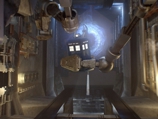
Following Amy and Rory's departure ("The Angels Take Manhattan"), the TARDIS went through another reconfiguration,
its new interior being smaller than the 'steampunk'-esque version
used during The Doctor's travels with the Ponds, with blue lighting
that was dimmed when the ship was empty and a more functional, straightforward
control console, most likely intended to reflect The Doctor's bleaker
mood after the loss of his friends. The Doctor initially kept the
TARDIS parked on an artificial cloud during his 'retirement' to the
Victorian era to keep himself removed from the rest of the world
- access to the ship was facilitated by a ladder that could be concealed
by a perception filter from a certain height and lowered only when
The Doctor needed it -, the ship's exterior even looking somewhat
weathered from the conditions it had been exposed to, but the ship
returned to its usual pure blue when The Doctor sprang back into
action.
 |
| Journey to the Centre of the TARDIS |
|
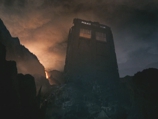
After The Doctor began to travel with the mysterious Clara Oswald, the ship began to demonstrate an erratic relationship with her (Possibly motivated by Clara’s paradoxical nature ("Asylum of the Daleks", "The Snowmen" and "The Bells of Saint John"), much like its dislike of Charley when she travelled with the Sixth Doctor ("Patient Zero")), the ship taking a while to translate some alien languages during Clara’s first trip to an alien world and not opening for her when she attempted to take a child to safety inside the ship without The Doctor present ("The Rings of Akhaten"), although it was willing to help Clara rescue The Doctor when he was trapped in a pocket universe despite its initial dislike ("Hide"). When the TARDIS was briefly depowered and claimed by a crew of salvage operators when they attempted to catch it with an illegal magno-grab, the resulting damage as The Doctor attempted to escape resulted in Clara being trapped in the TARDIS interior as the ship began to leak fuel. Having pretended to activate the TARDIS self-destruct to force the crew to help him search for Clara, The Doctor travelled deep into his ship, Clara discovering a monstrous creature deep within the TARDIS as one of the scavengers attempted to strip the console, only for the ship to burn him before he was attacked by the creatures. As it began to break down from engine damage, the ship generated ‘echoes’ of the console room as the safest location on the ship, The Doctor, Clara and the android scavenger being drawn to the console rooms as part of the TARDIS’s attempt to protect them, but this plan was complicated when a rift in the TARDIS created a time rupture that caused parts of the past to leak’ into the ship, resulting in The Doctor, Clara and the scavengers being attacked by burned, twisted figures that were later revealed to be what Clara and the scavengers would become when they were badly burned by the collapsing TARDIS. However, The Doctor was able to undo this catastrophe by travelling to the TARDIS’s damaged engine room and using the temporal rift to return to the moment when the accident occurred and prevent it by sending his past self the means of resolving the damage.
 |
| The Name of The Doctor |
|
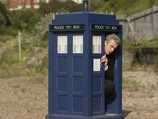
During a final trap by The
Great Intelligence, The Doctor was forced to visit his own grave, revealed to be the TARDIS itself, grown to giant size as the dimensional link keeping the interior and exterior dimensions separate broke down ("The Name of The Doctor"), the younger TARDIS attempting to keep The Doctor away until The Doctor shut down most of its power. This tomb could only be opened when The Doctor’s true name was uttered - the doors were opened by River Song’s ‘ghost’ speaking the name while everyone present was distracted -, the tomb manifesting as a TARDIS console room overgrown with various plants, a spiral of energy where the console had been representing the scar tissue left by The Doctor’s presence in the universe.
 |
| Flatline |
|
The Intelligence attempted to infect The Doctor’s timeline by entering the scar tissue, but Clara was able to negate its influence by entering the scar herself, undoing the damage caused by the Intelligence until The Doctor entered it to save her.
This version of The Doctor’s death was later undone when Clara managed to make contact with the Time Lords (Sent to safety after all thirteen Doctors froze Gallifrey in a parallel pocket universe during the Daleks’ final assault ("The Day of The Doctor")) to ask them to change the future when The Doctor was about to die on Trenzalore after a prolonged war with the Daleks, the Time Lords sending The Doctor the energy necessary to begin a new regeneration cycle, allowing The Doctor to regenerate once more and continue his travels ("The Time of The Doctor").
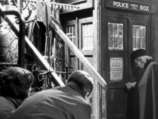
Having upgraded the console room to add various homely details such as chairs, chalkboards, and bookcases ("Deep Breath"), the Twelfth Doctor has continued to travel in the TARDIS with no problems. The only difficulty the ship has experienced to date was during the confrontation with the mysterious 'Boneless', two-dimensional beings whose attempts to infiltrate this universe resulted in them draining energy from the ship's exterior and interior dimensions, reducing the TARDIS exterior to the size of a toy and causing The Doctor to lose power, to the point that the TARDIS was damaged just by being dropped down a sewer, with The Doctor expressing concern that the ship could be destroyed if it was hit by a train until he activated 'siege mode'. With life support running out as the ship's power ran low, the Doctor was only saved when Clara was able to trick The Boneless into supplying the TARDIS with the power needed to regenerate its lost dimensions, allowing the Doctor to create a force field to repel The Boneless and send them back to their own dimension ("Flatline"). Although The Doctor was forced to steal another TARDIS to return to Earth after he was taken to Gallifrey by a complex trap ("Face the Raven" and "Heaven Sent/Hell Bent"), he soon set out to search for his original ship. Although Clara and the immortal Ashildir took the 'new' TARDIS after it was trapped in the form of a 1960s American diner, they left The Doctor's TARDIS behind, The Doctor appreciating the painting Clara's friend Rigys had done to turn its outer shell into a memorial for Clara before resuming his travels. |
| |
 |
| An Unearthly Child |
|
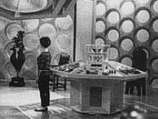 |
| An Unearthly Child |
|
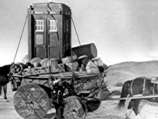 |
| Marco Polo |
|
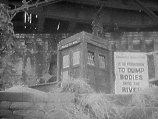 |
| The Dalek Invasion of Earth |
|
| |
|
|
|
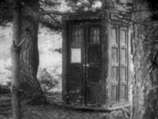 |
| The Highlanders |
|
 |
| The Faceless Ones |
|
 |
| The Tomb of the Cybermen |
|
 |
| The Web of Fear |
|
| |
|
|
|
 |
| Spearhead From Space |
|
 |
| The Ambassadors of Death |
|
 |
| The Time Monster |
|
 |
| The Green Death |
|
| |
|
|
|
 |
| Revenge of the Cybermen |
|
 |
| The Masque of Mandragora |
|
 |
| The Masque of Mandragora |
|
 |
| Logopolis |
|
|
| |
|