|
|
 |
|
The
First Doctor
(1963 - 1966 & 1973) |
|
|
|
|
|
|
The
Sound Vault |
|
 |
|
 |
|
| Susan |
|
|
The Best Doctor
|
| |
| Vote
if I am your favourite Doctor |
|
|
|
|
|
| |
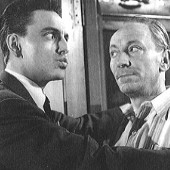
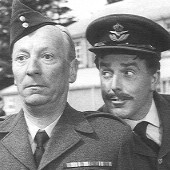
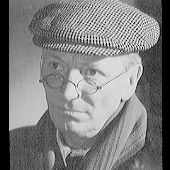
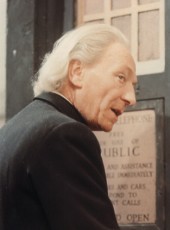
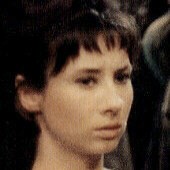
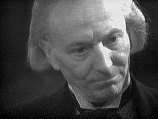
 When The Doctor’s travels began, William Hartnell played The Doctor as a wonderfully eccentric grandfather figure with a heart of gold, crotchety and prone to criticise others for their perceived stupidity, but with a sharp intellect and a concern for others especially his 'granddaughter', Susan. However, as further material has been published over the years, we have learned even more about The Doctor's life prior to his initial departure from Gallifrey and his fateful materialisation in the junkyard at Totter’s Lane where he was first introduced, as well as the circumstances that resulted in him leaving his home in the first place. When The Doctor’s travels began, William Hartnell played The Doctor as a wonderfully eccentric grandfather figure with a heart of gold, crotchety and prone to criticise others for their perceived stupidity, but with a sharp intellect and a concern for others especially his 'granddaughter', Susan. However, as further material has been published over the years, we have learned even more about The Doctor's life prior to his initial departure from Gallifrey and his fateful materialisation in the junkyard at Totter’s Lane where he was first introduced, as well as the circumstances that resulted in him leaving his home in the first place.
 |
| The Aztecs |
|
However, even amid all the answers we have learned over the years about The Doctor's past prior to the show, his exact origins are a mystery. Some sources suggest that his father was a Time Lord known as Ulysses while his mother was a human from the Victorian era known as Penelope Gate, with the Eleventh Doctor in particular mentioning that he was once an infant to the point of donating what he claimed was his old cot to the newborn child of his current companions ("A Good Man Goes to War"). Other sources suggests that The Doctor is the 'reincarnation' of the Other, one of the first, greatest and most mysterious Time Lords to ever exist, potentially greater even than Rassilon and Omega, who sacrificed himself to create the genetic Looms that allowed Gallifrey to continue despite the curse of sterility imposed on the planet by their one-time ruler, the Pythia. On another occasion, The Master claimed that he had found evidence that The Doctor was the ‘Timeless Child’, a child retrieved from another dimension who had the gift of perpetual regeneration and was used to provide the rest of Gallifrey with that particular ability, but this source is obviously of questionable value and may just be another variation of the theory that The Doctor is the Other. While it is unclear if any of these explanations are genuine, when the generally stagnant nature of Time Lord society is taken into account, it is clear that the independently-thinking Doctor is far from being a normal Time Lord regardless of the precise details of his origins.
Despite these mysteries, however, it is known for a fact that, while at school, The Doctor was a surprisingly independent individual for a Time Lord, preferring to do his own thing rather than automatically obey all the rules and restrictions that were forced upon him by the society he lived in. Although he lived in the house of Lungbarrow, only his cousin Innocet was ever kind to him, with his other relatives teasing him for his attitude. The Doctor was so isolated as a child that he actually created an imaginary enemy rather than an imaginary friend, in the form of Mandrake the Lizard King - really a dead lizard The Doctor found pinned to an old engine component in the mountains - but abandoned this childish fantasy when he began to attend the Academy and form real friendships, acknowledging even back then that his greatest enemy was loneliness ("The Widow's Assassin"). Despite his unconventional perspective, the future Doctor began to form actual friendships when he was at school, but he was still seen as a bit of an outsider even by his fellow student in the Deca, the ten most elite students of their year of the academy (Who included his future enemies, such as Koschei (The Master), Ushas (The Rani), Mortimus (The Meddling
Monk), and Magnus (The War Chief)). Koschei and The Doctor in particular were close friends ever since they were children, their family estates being close by each other ("The End of Time"), although The Doctor also dealt with his share of bullying from children such as Torvic and Anzor, their treatment being so rough that The Doctor accidentally killed Torvic as a child (Although a subsequent deal with Death transferred his guilt and memory of this action to The Master) ("Master") and he retained a fear of Anzor well into his sixth incarnation ("Mission to Magnus"). At some point during his career at the Academy, The Doctor wandered into the cloister room that served as the physical representation of the Matrix archives and was trapped for four days until he did the impossible and escaped, musing that he was driven slightly mad from what he witnessed, as well as learning the true secret of an ancient prophecy of a hybrid that would destroy Gallifrey ("Heaven Sent/Hell Bent"). During one particularly low moment in his life, when temporarily suspended from the Academy for his rebellious attitude after refusing to return to Lungbarrow for Otherstide and his Nameday ("Divided Loyalties"), The Doctor convinced his friends Rallon and Millenia to accompany him on a quick trip away from Gallifrey to confront the being known as the Celestial Toymaker, resulting in Ruath being taken as the Toymaker's host and Millenia being trapped in his toyshop as a living doll. The Doctor was released, but only because the Toymaker foresaw that he would be a worthy opponent later in life when he'd had the chance to mature. Although The Doctor was expelled from the academy as a result of his actions, he was eventually re-admitted after acquiring his doctorate, but despite earning the personal attention of teachers such as Borusa ("The Deadly Assassin") and Azmael ("The Twin Dilemma"), his rebellious attitude meant that he never committed himself to his studies, to the point that he never even bothered taking his time-travel proficiency test - essentially the Time Lord equivalent of a driving test - ("Festival of Death"), and only passed his qualifying exams to become a Time Lord with 51% on the second attempt (Although one source suggests that he did this to avoid attracting attention to himself to make it easier for him to leave Gallifrey later ("Tears of the Oracle")).
 |
| The Web Planet |
|
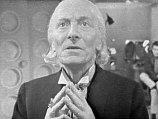
Although he began to earn a more public reputation when he campaigned for the destruction of the Miniscopes, believing them to be offensive to the life-forms used within them ("Carnival of Monsters" and "The Empire of Glass"), The Doctor's reputation on Gallifrey continued to go downhill, his life tainted by his knowledge of the prophecy about the hybrid. He also admitted near the end of his first life that he was intrigued at the nature of the balance between good and evil in the universe, musing that it made no sense for evil to lose so often when faced with the loyalty and self-sacrifice that defined 'good', often wondering what created such a balance ("Twice Upon a Time"). Eventually forbidden to return to his family home after a series of minor rebellions, to the point that he was 'replaced' by a new Cousin in the form of Owis, The Doctor was nevertheless invited back when Quences, the head of his family house of Lungbarrow, was called upon to read his will, but refused to do so until The Doctor was present, having decided to make him his successor. During a confrontation with his cousin Glospin - who sought to taunt The Doctor about proof he'd obtained that seemed to prove The Doctor wasn't a member of the House of Lungbarrow - the sudden appearance of the Hand of Omega drove Glospin off and forced The Doctor to flee in an old Type 40 that had left itself unlocked ("The Doctor's Wife") after the ship was recommended to him by a fragment of his future companion Clara Oswald ("The Name of The Doctor"), accidentally travelling into Gallifrey's distant past. Arriving in the strangely familiar streets of his world's past, The Doctor met a strangely familiar girl who instantly recognised him as her grandfather, and, somehow, he knew that her name was Susan. Together, they departed Gallifrey to explore Time and Space, knowing that neither of them could ever return home again.
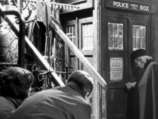
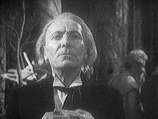
Already intrigued by Earth since childhood ("Divided Loyalties"), The Doctor's interest in the planet increased when his initial trip led him to Earth's moon and gave him a chance to watch a 'first contact' video ("The Beginning"). During a brief trip to a human colony in the future, The Doctor adopted his old nickname as an official title for himself for the first time when he was given the clothing of a Doctor after his old clothes was damaged ("Frayed"), subsequently developing an increased interest in humanity that led to him deciding to establish a home for himself on Earth in 1963. After breaking the Time Lord's anti-interference policy - a belief so deeply ingrained into Time Lord society that The Doctor was initially unable to do anything against it despite his own nature - by defeating a being called the Cold ("Time and Relative"), The Doctor was first directly introduced to an audience in the middle of a dark and gloomy junkyard on a foggy night in London. The first impression is of a cantankerous old man who is very angry and quick to blame others like when schoolteachers, Barbara Wright and Ian Chesterton, force themselves inside the TARDIS, leaving him feeling that he has no other choice but to take off with them inside, leaving him unable to take them back to their own time due to his currently-erratic piloting skills - implied to be the result of either damage to the ship or security programs created by his own people ("Heart of TARDIS") and with the TARDIS's chameleon circuit swiftly becoming stuck as a police box ("An Unearthly Child").
 |
| The Daleks |
|
However, his quick and intelligent mind, and his keenness for solving problems and for talking his way out of difficult situations, meant that he was soon respected by Barbara and eventually Ian who both realised that under his gruff exterior was a person who they could trust, the initial hostility between the group swiftly ending after they worked together to defeat the Daleks ("The Daleks") and save the TARDIS from destruction in the Big Bang ("The Edge of Destruction"). The Doctor also grew to respect both of them when he realised that they were not a threat to him or Susan and that their abilities could be used to his advantage, with Ian in particular helping The Doctor handle the more physical side of their adventures through time and space. The two of them as a whole provided The Doctor with the human influence that he would greatly need in his travels through the universe and his fights against evil wherever he found it, encouraging him to get involved in some of the affairs he found himself discovering during his travels as they investigated various strange mysteries on the planets they arrived on, their presence providing The Doctor with his first glimpse of humanity's potential as a species as well as inspiring his own passion for travel even further.
Throughout the whole of the First Doctor's era his exact origins were never revealed, except that he is not from Earth, although his truly alien origins were concealed due to him only possessing a single heart (Time Lords grow the second one upon their first regeneration, as revealed in "The Man in the Velvet Mask") and no reference being made to his explicit age. He liked to get his own way and was always eager to investigate, despite frequent warnings to his companions about the dangers of interfering in case they ended up being 'carried away with the flood' of events they couldn't change "The Reign of Terror"). As a result, in his early days he typically only became involved in the affairs he encountered when outside circumstances prevented him from leaving directly, such as when a component of the TARDIS was lost during their temporary captivity by the Daleks ("The Daleks"), when outside forces prevented them from returning to the TARDIS ("The Sorcerer's Apprentice", "The Keys of Marinus"), or simply losing the TARDIS key, although he clearly still felt a great deal of compassion and respect for the people involved, praising the resolve of the people of Sarath as they fought to survive even as their moon fell towards their planet ("City at World's End").
 |
| The Romans |
|
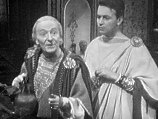
His initially rigid opposition to interference was particularly reflected in his clothing; while other Doctors tend to wear the same clothes regardless of the era they are currently visiting, this Doctor regularly altered his attire to better blend in to the past eras he visited, even wearing a toga during his time in Rome ("The Romans"), although he retained his Victorian-based costume when visiting the future and other planets. However, as time went on, while he still protested against the casual interference of his old friend Mortimus - now known as The Meddling Monk - as he attempted to alter the outcome of the Battle of Hastings simply because he thought it would be 'more fun my way' ("The Time Meddler"), as time went on, The Doctor began to recognise that he had a duty to protect the innocent where he could, standing up for those who needed a champion in their darkest moments against the forces of those who would seek power at the cost of others.
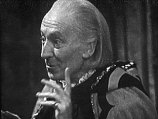
He was always protective towards all of his companions but especially Susan and was always concerned for her safety and well-being, particularly after he violated his peoples' rules against changing history to protect mankind from a dystopian 2006 created by flawed time-travel experiments and the power of the ruthless Machine ("The Time Travellers"). As a result, when The Doctor realised that Susan was quickly growing up and had fallen in love with a resistance fighter on Earth, he forced her to leave him by locking her out of the TARDIS. 'One day, I shall come back. Yes, I shall come back. Until then, there must be no regrets, no tears, no anxieties. Just go forward in all your beliefs, and prove to me that I am not mistaken in mine. Goodbye, my dear. Goodbye, Susan' ("The Dalek Invasion of Earth"). (A promise that he eventually fulfilled in his eighth incarnation ("Legacy of the Daleks" and "An Earthly Child")).
 |
| The Crusade |
|
Following Susan's departure, he came to see some of his subsequent companions, such as Vicki and Dodo, as being almost 'Susan substitutes', each of them reminding him of his granddaughter in some way, although this apparent desire to 'keep' some part of Susan with him on his travels ended after his first regeneration. Although he sometimes argued with companions such as Steven and Ian on various ethical matters, his dedication to and affection for his friends remained evident regardless of their personal conflicts, particularly when Steven attempted to leave him and he was briefly left alone in the TARDIS for the first time since his travels began, The Doctor began to wonder whether he should return home before he recognised that he couldn't do such a thing yet ("The Massacre of St. Bartholomew's Eve"). Although he briefly sought solitude as he prepared for his imminent regeneration ("The Man in the Velvet Mask"), after Dodo's departure ("The War Machines") he was clearly grateful when he realised that Ben Jackson and Polly had wandered into the TARDIS ("The Smugglers").
Although he was initially more willing to commit murder than his later selves, a confrontation with his eighth self and Ian Chesterton's own reaction to his near-efforts soon prompted The Doctor to re-evaluate his old arrogance, The Doctor coming to appreciate the value of life and avoid confrontation. Mostly, he was content to observe in the background and develop plans, although he was never afraid to take centre stage when the occasion called for it, such as when he confronted the power-hungry sorcerer Gramling ("The Sorcerer's Apprentice") or stood up to the ruthless Schirr terrorists known as the Ten-Strong, who had terrorised Earth's future empire for decades ("Ten Little Aliens"). He would only get involved fighting against injustice and oppressors when events got out of control and then only resorting to violence where necessary preferring to use diplomacy. He did however at times become so engrossed with events happening around him that he allowed his judgement to become clouded. His passion for discovery and righting the wrongs of the universe made him a truly likeable Doctor if not frustrating at times for his companions, most notably with his habit of constantly getting Ian's name wrong (Calling him everything from 'Chesterfield' to 'Chatterton'), and his relationship with later companion Steven Taylor could be occasionally strained due to Steven's desire to help others being countered by The Doctor's concerns about interfering with history, even if Steven eventually came to accept that The Doctor simply adopted a larger view rather than dismissing Steven's concerns ("The Massacre of St. Bartholomew's Eve" and "Salvation").
Despite his age and apparent absent-mindedness, this Doctor's mind and burned as sharply as any of his other selves, allowing him to quickly deduce that a massive spaceship being constructed on the distant planet of Sarath was a fake based on nothing more than a couple of casual slips of the tongue and a visual estimation of its mass and power capabilities ("City at World's End"). Despite his initially darker nature, he still valued independence over conformity, satisfied with the destruction of the Conscience of Marinus despite its role in bringing peace to Marinus as he felt that machines could never dispense true justice in place of humans ("The Keys of Marinus") and expressing distate for the Elders' oppression of the Savages despite the benefits of their life-draining technology in preserving their own citizens ("The Savages"). His strength of will was also significant, when faced with the Gods of Myth, beings whose powers and abilities were based around the belief others had in them, The Doctor escaped being burnt to death because his belief in himself outweighed the belief that an entire park full of people had in the God who had hurled a fireball at him ("Salvation"), and on another occasion he was able to single-handedly hold back a mental pulse capable of immobilising eight people with only his mind, although it left him fatigued from the effort ("Ten Little Aliens").
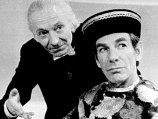 |
| The Celestial Toymaker |
|
Even though he had a keen mind The Doctor did suffer sometimes from poor health and would at times become breathless when trying to keep up with his more active and younger companions, a fact that often frustrated him given his relative youth by Time Lord standards. Although he could be sprightly when called upon, such as when he fought against a skilled martial artist ("The Eleventh Tiger") or against his robotic duplicate ("The Chase"), he typically paid for it later by being even more fatigued than usual afterwards. For a time he attempted to resist his approaching regeneration, afraid at the thought of losing a part of himself in the transformation, even trying to set things up so that his companions would leave him alone when the moment to change finally came to pass, influencing Steven Taylor to serve as leader of a group of humans in the distant future ("The Savages") and sometimes contemplating doing the same to Dodo ("The Man in the Velvet Mask"). He overcame the worst of this pain after his confrontation with the mysterious mask-makers responsible for twisting Earth's history, but when the Daleks attempted to alter his history by diverting the TARDIS from its 'original' destination of the South Pole to the small village of Lewes ("The Bonfire of the Vanities"), The Doctor became increasingly weary as his travels continued beyond his original life-span.
Although he survived these experiences, eventually the Time Lords of the future were forced to get in touch with a wandering Time Lord who identified himself only as 'the Player' to ensure that The Doctor was aware that he had to return to the South Pole to protect time so that he would regenerate as appropriate ("The Plague of Dreams"). After saving Earth from the return of its twin planet Mondas and the first confrontation with the Cybermen ("The Tenth Planet"), The Doctor finally passed the point where he could continue to hold off his regeneration completely, due to exposure to the cold environment of the South Pole and Mondas's energy-draining effects. With Earth saved and the Cybermen defeated, The Doctor returned to the TARDIS, although he was briefly diverted by a Vardan plot that saw part of his essence drawn to Steven's new home as a Vardan that had become trapped in his and Steven's minds tried to restore itself ("The Locked Room") until they were able to trap it with a digital recreation of The Doctor's mind. Returned to his body, The Doctor still resisted regeneration - entering a state of grace where he could operate at full health in his current body for a few hours until he had to regenerate or die - but was surprised to discover the Twelfth Doctor at the South Pole, the future Doctor also resisting the 'need' to regenerate out of a fear of change ("World Enough and Time/The Doctor Falls"). As they came face to face, the two Doctors were confronted by Testimony, an organisation from the future that gathered the memories of the dying to record them for all eternity ("Twice Upon a Time"), the paradox of two Doctors in one place disrupting Testimony's attempts to return a British captain to the time of his death in the First World War. Initially horrified at his future selves' reputation of 'The Doctor of War', after witnessing the Twelfth Doctor bend the Laws of Time to save the captain's life, the First Doctor recognised that being the 'Doctor of War' meant that his future self was not the man who sought conflict, but the man who sought the moments of peace within such conflict. Reflecting that this was a destiny he could be proud of, the First Doctor returned to the TARDIS and travelled back to the South Pole, collapsing just as Ben and Polly returned to the ship, subsequently changing into a much younger and dark haired man ("The Tenth Planet").
 |
| The Three Doctors |
|
The character of the First Doctor also appeared in the 10th anniversary story "The Three Doctors" (Albeit trapped in a time eddy and only able to advise his two future selves), and also the 20th anniversary special "The Five Doctors", and the 2017 Christmas Special "Twice Upon a Time", with the role being played by Richard Hurndall and David Bradley respectively in later appearances. His mental 'ghost' also appeared to the Seventh Doctor's companion Ace when she was trapped in The Doctor's mind during the final fight against the Timewyrm ("Timewyrm: Revelation"), where he was portrayed as an elderly Librarian guarding The Doctor's memories inside his mind. Despite his greater physical age and short temper compared to his other selves - indeed, the Fourth Doctor once referred to his first incarnation as 'the grumpy one' ("Dimensions in Time") - during later meetings he would often mentally outstrip his future incarnations, deducing the true nature of the Game of Rassilon before the Second, Third and Fifth Doctors ("The Five Doctors"), swiftly working out how the amnesic Eighth Doctor might regain his memories ("The Eight Doctors") (Although the Eighth gave the First a lecture on morality at the same time) and quickly identifying the true purpose of the time bridge sent by Omega to capture the Third Doctor, the Second Doctor later confirming that he had a great deal of respect for his first incarnation's advice ("The Three Doctors"), and noticed key details about the glass figures used by Testimony to collect data through simple observation where the Twelfth Doctor had to use sonic sunglasses for the same result ("Twice Upon a Time"). When he met the Twelfth Doctor, although the Twelfth was embarrassed at the First's more sexist attitude while the First was horrified at his future title of 'The Doctor of War', both men soon came to accept the other, recognising that they were The Doctor no matter what else changed about them, a recreation of the Twelfth Doctor's companion Bill Potts observing that The Doctor himself was the answer to his childhood question of what kept good and evil in balance in the universe ("Twice Upon a Time").
|
|


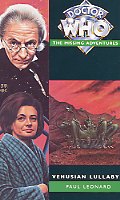

 BOOK
BOOK