|
|
 |
|
Kamelion
(1983 - 1984) |
|
| Gerald Flood (voice only) |
|
Gerald Flood was born in Portsmouth, the son of a Naval
family. He was a wireless operator during the Second World
War and worked as a filing clerk after the War ended until
he landed a job with the
Farnham Repertory Company.
He toured in rep, and appeared
in productions including Hamlet, Power and Glory and Charley's
Aunt.
In 1960 he
performed in The Complaisant Lover at the Globe
Theatre and went on to appear in The Formation Dancers, Children’s
Day and There's A Girl In My Soup.
In the
1960’s he
appeared in a science fiction series Pathfinders
in Space (1960), and its sequels Pathfinders
to Mars (1960-1961) and Pathfinders to Venus (1961).
Other television roles followed, including The Ratcatchers (1966/67), Third Time Lucky (1982)
and (after Doctor Who) Bleak
House (1985). He also guest starred
in episodes for shows like Randall
and Hopkirk (Deceased) (1969), Steptoe and Son (1970), Tom Brown's Schooldays (1971), Paul Temple (1971) and Return of the Saint (1979).
His
film roles included Black Beauty (1946), Patton (1970), Smokescreen and Frightmare (1974).
He
died in April 1989. |
|
|
|
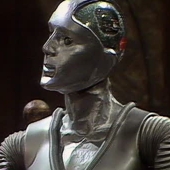
 Kamelion is, in many ways, The Doctor’s
most tragic companion, possessing so much potential - both
in reality and in The Doctor’s fictional universe -, and yet lacking
the ability to explore so much of it due to circumstances beyond his
control. A completely
artificial companion in both contexts - he was actually a
remote-controlled robot specifically designed for Doctor Who rather than
a man in a costume
-, Kamelion’s opportunities to participate in the TARDIS’s
travels were limited from the beginning in the real world due to the death of the only member of the production crew who truly understood
how to operate him
before his first episode was filmed, restricting his role
in the series from the start. Kamelion is, in many ways, The Doctor’s
most tragic companion, possessing so much potential - both
in reality and in The Doctor’s fictional universe -, and yet lacking
the ability to explore so much of it due to circumstances beyond his
control. A completely
artificial companion in both contexts - he was actually a
remote-controlled robot specifically designed for Doctor Who rather than
a man in a costume
-, Kamelion’s opportunities to participate in the TARDIS’s
travels were limited from the beginning in the real world due to the death of the only member of the production crew who truly understood
how to operate him
before his first episode was filmed, restricting his role
in the series from the start.
 |
| The King's Demons |
|
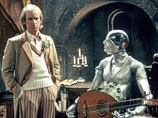
In the context of the show itself,
Kamelion was a shape-shifting artificial life-form designed by an ancient
race, possessing
a pseudo-metabolic extension into the fifth dimension that
would allow him to store or draw
on additional mass to suit varied body forms, who was discovered
by The
Master when he was temporarily trapped on the planet
Xeraphim in the
distant past. With Kamelion’s programming causing him to be automatically
loyal to the strongest mind in his immediate vicinity, Kamelion
was swiftly taken over by The Master, who used him as his puppet in various
schemes
across the universe, Kamelion’s ability to completely transform
his physical appearance - even his ‘default’ form was merely
a disguise, although we never learned precisely what he would
look like without any disguises - making him an invaluable
tool. However, although
Kamelion lacked the ability to defy The Master, he still
possessed some degree of free will, causing him to become
increasingly uncomfortable
with the roles The Master forced him to play, leaving him
longing for an alternate to The Master even as his nature
compelled him to obey the
Time Lord.
 |
| The King's Demons |
|
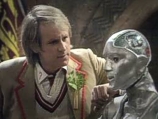
Kamelion eventually appeared
to gain his freedom when The Master had him pose as King
John in an attempt to alter the outcome of
the signing of the Magna Carta. Although the ‘king’ initially
attempted to use the arrival of the TARDIS to further The
Master’s
ambition to discredit the king, with the king introducing
the Fifth
Doctor, Tegan
Jovanka and Turlough as
his ‘demons’, The
Doctor eventually saw through The Master's deception after another knight confirmed that the true king was in London, subsequently discovering Kamelion's true identity. In a battle of wills between the two Time Lords, The Doctor appeared to win control of Kamelion away from The Master and sent him into the TARDIS, Kamelion subsequently expressing a keen interest in remaining with The Doctor despite
Tegan and Turlough’s initial distrust of him due to his origins.
 |
The Crystal Bucephalus
(Craig Hinton) |
|
Although
automatically designed as a slave, Kamelion demonstrated
a certain degree of free will even when under the control
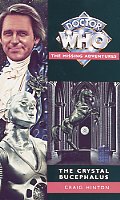
of another. A particular example of this can be seen in Kamelion's first true experience in the TARDIS after an attempt to have a meal resulted in The Doctor, Tegan and Turlough being accidentally taken to the time-travelling restaurant the Cyrstal Bucephalus in the far future ("The Crystal Bucephalus"). With The Doctor trying to investigate a murder, Turlough returned to their point of origin to retrieve the TARDIS and take it to the Bucephalus himself, but when Kamelion tried to leave the TARDIS to help, he was taken over by the criminal psychopath Maximillian Arrestis. Fortunately, Kamelion was able to resist Arrestis's orders to a degree at a crucial moment; when Arrestis ordered him to turn into something dangerous to threaten Arrestis's enemies, Kamelion obeyed the order by transforming into a Sculti, a race that generated a bio-electric field capable of shutting down the human brain, but neglected to inform Arrestis that the same field could also shut down the energy weapons that Arrestis was using. This temporary advantage allowed The Doctor to gain the upper hand in the subsequent confrontation and send Arrestis - who had been rescued from the moment of his own death - back to the point in time where he'd come from, while Turlough and Kamelion destroyed the core of the Bucephalus's time-travel ability and Tegan prevented some of Arrestis's associates taking control of the TARDIS. Kamelion expressed some concern about his perceived failure at this time, but The Doctor was apparently able to convince him to continue taking part in their journeys.
 |
Devil in the Mist
(Cavan Scott) |
|
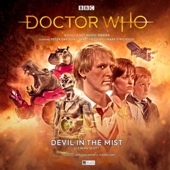
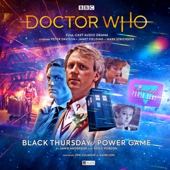
Unfortunately, Kamelion's time in the TARDIS continued to be a challenge even when there wasn't an actual threat. When the ship materialised on a prison ship transporting Nustanu, a dangerous criminal capable of mind control ("Devil in the Mist"), even after the criminal was killed in the subsequent crash, Kamelion briefly appeared to have fallen under Nustanu's influence, when in reality it was just Tegan's distrust of him causing him to act as though he was under Nustanu's control because Tegan 'expected' him to be. Even after The Doctor confirmed that Kamelion wasn't under anyone's control, he then fell under the influence of a controlling intelligence guarding a healing spring, forcing The Doctor, Tegan and Turlough to bargain with the intelligence to release Kamelion and let them use the springs to heal The Doctor's current paralysis. While the four were able to return to the TARDIS in safety, Kamelion's nature again worked against his allies again when they became caught in a mining accident in Wales in 1902 ("Black Thursday"). After Kamelion was present at the deaths of a husband and son who were caught in the accident, he formed a link with their wife/mother due to her intense grief, nearly killing the daughter of the mine-owner before the woman revealed that the girl was her daughter as well.
 |
Black Thursday/Power Game
(Jamie Anderson and Eddie Robson) |
|
When The Doctor's attempt to take a holiday in New York accidentally led to them materialising in York, Kamelion again fell victim to an alien threat when another-dimensional entity managed to take remote control of him ("Power Game"), forcing him to gather humans to collect power sources for her weapons. The influence of the Hostess enhanced Kamelion's abilities to the extent that he was able to create an entire reality television show, projecting it as a pirate signal onto all television sets in the local area while preventing any of those watching or participating in the show questioning the anomalies of the situation. However, after Tegan and Turlough were forced to take part in the show, The Doctor learned what was happening and was able to disrupt the effects used for the show by interfering with her link to Kamelion, forcing the Hostess to return to her dimension and be punished by her people for her actions.
 |
The Kamelion Empire
(Jonathan Morris) |
|
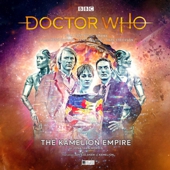
As they left York, the TARDIS received a signal from Kamelion's own home planet, drawing him back along with others of his kind. After they followed the signal to a deserted world, The Doctor learned that Kamelion's original designers had been the centre of a vast empire, after the native Kamile uploaded their minds to the Locus when their planet suffered an environmental catastrophe that made it impossible to sustain life, using the Kamelion as a means of remotely enforcing their will on other worlds (The Doctor noted that this didn't match The Master's original description of Kamelion's history, but Kamelion observed that The Master was a notorious liar). Eventually, the Kamile within the Locus came together as four distinct factions that were essentially amalgamations of the original individual personas uploaded into it, titling themselves Authority, Liberty, Harmony and Chaos, with these factions eventually coming into conflict in a day-long war that involved their entire empire and its artificial intelligences. By the time the TARDIS arrived, Chaos had won the day-long conflict centuries ago, but had been unable to expand its control as the systems that allowed it to command the Kamelion robots had been destroyed in the war.
Drawing on its new control of Kamelion, Chaos tried to take control of the TARDIS by using the TARDIS crew as hostages, but Kamelion retained just enough control of himself to stop his body being used to harm his friends. Although Chaos was able to take the TARDIS back in time to try and prevent the destruction of the Kamelion control interface, The Doctor, Tegan and Turlough were able to get on board and trick Chaos's past self into destroying the redundant memory node Chaos had hidden the control program in. Chaos tried to retake control of the TARDIS, but The Doctor prevented this by deliberately sabotaging the main console room, subsequently luring Chaos-in-Kamelion into a secondary console room after setting the systems so that the TARDIS door could only be opened from outside. Using dormant Kamelion robots as their 'avatars', The Doctor, Tegan and Turlough faked their deaths as Chaos 'killed' their avatars, allowing The Doctor to access the Locus and trap Chaos back in the system, freeing Kamelion from his control. Despite the final defeat of his creators, Kamelion initially requested that he be abandoned on that planet so that he couldn't hurt anyone else, only accepting a compromise where he would remain in an isolated room in the TARDIS, trying to protect himself from being used by others against his friends.
 |
Forty 2 - The Auton Infinity
(Tim Foley) |
|
With the rest of the crew accepting his request, Kamelion was generally left alone in the TARDIS by the others baring a brief occasion
when Tegan had him
assume the form of the Fourth Doctor to show Turlough what
The Doctor looked like when
she first met him after their meeting with The Doctor’s first three
selves ("The
Five Doctors"), Unfortunately, this caused Kamelion to suffer an overload as he tried to access Tegan and Turlough’s subjective experiences and impressions, prompting The Doctor to provide
him with a casket to shield him from data he couldn’t process properly
("Qualia").
Kamelion's leisure time was generally spent linked up to the TARDIS’s
databanks and learning more about its adventures, finding
a certain similarity in their histories given their mutual
background as shapeshifters serving
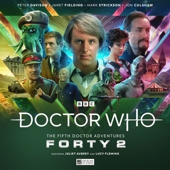
the same master. However, the android played an important role when the TARDIS interior was displaced from its exterior when The Master stole the ship to help him create a time bridge to a vortex driller he had stolen to ‘assist’ a lone Auton as part of his latest scheme ("Forty 2 - The Auton Infinity"). When a copy of The Doctor’s consciousness from early in his fifth body was displaced in time and projected into his future, inhabiting an Auton body created by The Master as part of a sick joke, The Master tried to use this consciousness as a pilot for the driller after the truth Fifth Doctor escaped. The strain of this allowed the other Doctor to separate himself from his collapsing Auton body and manifest in the displaced TARDIS interior as the original Nestene Consciousness manifested in orbit of Saturn, trying to take control of the vortex driller. While this Doctor hadn’t met Kamelion yet, he accepted the explanation for his future companion’s presence and the two worked together to find a way to displace the Consciousness back into the vortex, using the displaced Doctor’s previous TARDIS trips to help create a suitable time rift to banish the Consciousness.
 |
Imperial Moon
(Christopher Bulis) |
|
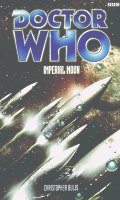
Although Kamelion returned to his room after this, he was recalled to active ‘service’ when The Doctor and Turlough tried to investigate a British expedition to a mysterious hunting park on the Moon in 1878. Turlough initially asked Kamelion to come and actively assist them, suggesting that he could operate in hiding to avoid awkward questions, but the park was protected by an energy shield designed to contain an atmosphere that disrupted Kamelion's systems when he tried to leave the TARDIS with the others. Once The Doctor, Turlough and the expedition members shut down the field, Kamelion was able to rescue The Doctor when he nearly suffocated in the crater as the oxygen began to fail with the rest of the park, his telepathic link to The Doctor making it easy to find his mind among the animal life. After they rescued Turlough from one of the ships, the TARDIS crew realised that the returning expedition had been 'infiltrated' by the ruthless Vrall and returned to the park to retrieve weapons to use against the Vrall before they could escape to threaten the rest of the world. Once the Vrall had been defeated, The Doctor had Kamelion pose as a vision of Prince Albert to
convince Queen Victoria to abandon
further efforts at space travel after helping The Doctor
and Turlough defeat the ruthless Vrall before they could
launch a full-scale assault
on Earth ("Imperial
Moon").
 |
| Planet of Fire |
|
Shortly after this, however,
Kamelion’s
legacy as The Master’s ‘tool’ came
back to haunt him. Having recently been shrunk to the size
of a doll while trying to increase the power of his Tissue
Compression Eliminator,
The Master was forced to use a remote control room to enhance his still-present telepathic link with Kamelion, influencing the android to take the TARDIS to the planet Sarn, where The Master could use the numismaton gas - a powerful healing agent if channelled properly
- generated by
the planet’s core to restore himself. Despite the best efforts
of The Doctor, Turlough, and new companion Peri - whose will
proved powerful enough to temporarily override The Master’s control
over Kamelion on brief occasions - to free him from The Master’s influence, after The Master was apparently incinerated by the fire, Kamelion finally asked The Doctor to kill him to prevent him from ever being used
against his friends again, The Doctor reluctantly complying
with his request by using The Master’s own TCE ("Planet
of Fire").
 |
The Ultimate Treasure
(Christopher Bulis) |
|
Even after this tragic loss,
however, Kamelion’s legacy
remained. Although The Master once attempted to use his and
The Doctor’s
link to Kamelion to ‘encourage’ The Doctor to die during
his fifth regeneration - The Doctor requiring telepathic
assistance from his former companion Nyssa to find the necessary
strength to find the
mental manifestation of the Watcher in his ‘dream’ ("Circular
Time: Winter") -, Kamelion himself made a brief, unexpected
return to aid the Fifth Doctor and Peri when they found themselves
participating in the search for the mythical treasure of
Rovan Cartovall ("The
Ultimate Treasure"), lost for centuries on the planet Gelsandor
and guarded by the mysterious Seers. Due to his link with
the TARDIS and his partial existence in other dimensions,
a portion of Kamelion’s
personality remained despite his physical death, the Seers
using that fragment to create a new body for Kamelion in
the form of the unicorn-like
armoured creature known as Red (His body was based on Peri’s thoughts
of heroic dogs and knights). Although his body proved to
be too unstable to last for long, Kamelion died content after
he was able to help The
Doctor and Peri face the challenges of Gelsandor, saving
Peri from a crashed ship, driving away insane villagers who
threatened to execute The Doctor, and protecting them and their allies from a deranged android. When the Tenth Doctor was trapped in the TARDIS's telepathic circuits by a psychic parasite ("The Forgotten"), he was aided by a telepathic interface from the TARDIS that manifested as his old companions, the interface once transforming into Kamelion to bypass a forcefield that would have been dangerous to any organic lifeform that tried to use it.
|
|
|